
Written by: Anish Rao, Head of Growth, Listen Labs | Last updated: April 15, 2026
Key Takeaways for Reducing Bias in Qualitative Research
-
Biases like observer, confirmation, and selection bias distort qualitative data collection and interpretation, which can lead to flawed business decisions.
-
AI reduces observer and researcher bias through objective algorithms that analyze interviews without human preconceptions or expectations.
-
Confirmation and interpretation biases decrease when AI processes entire datasets impartially and surfaces unexpected insights humans might overlook.
-
Listen Labs addresses selection, cultural, and interviewer biases through its 30M+ global respondent network, 90+ language support, and consistent AI moderation.
-
Experience comprehensive bias elimination across all 9 common types with Listen Labs and see how AI removes human subjectivity from your research process.
9 Bias Types That Commonly Distort Qualitative Research
1. Observer and Researcher Bias in Qualitative Studies
Observer bias occurs when researchers unconsciously influence data collection or interpretation based on their expectations, beliefs, or theoretical frameworks. This systematic error can appear during interview moderation, data coding, or theme identification.
Traditional mitigation strategies include triangulation with multiple researchers, reflexivity practices where researchers examine their own biases, and peer debriefing sessions. Listen Labs’ Research Agent reduces observer bias by processing interview data through objective algorithms that identify themes and patterns without human preconceptions influencing the analysis.
2. Confirmation Bias in Hypothesis-Driven Research
Confirmation bias represents the tendency to search for, interpret, and recall information that confirms pre-existing beliefs while giving less consideration to alternative possibilities. This bias particularly affects hypothesis-driven research where teams seek validation rather than discovery.
Member checking with participants and systematic negative case analysis help counter confirmation bias in traditional research. Listen Labs’ AI analysis engine processes all interview data without predetermined hypotheses, identifies patterns across extensive datasets objectively, and surfaces unexpected insights that human analysts might dismiss or overlook.
3. Hawthorne and Response Bias in Participant Feedback
Hawthorne effect describes how participants modify their behavior when they know they are being observed or studied. Response bias encompasses broader changes in participant answers due to social desirability, demand characteristics, or perceived expectations.
UX prototype testing often suffers from Hawthorne bias when users provide overly positive feedback because they know researchers are watching and want to be helpful. Participants may claim they understand interface elements that actually confuse them, which creates false validation of problematic designs.
Addressing these validation challenges requires both traditional and AI-powered approaches. Structured interview protocols and indirect questioning techniques help minimize response bias. Listen Labs’ Quality Guard monitors interviews in real time for behavioral inconsistencies and social desirability patterns, while AI moderation creates consistent, non-judgmental interactions that encourage authentic responses across thousands of simultaneous interviews.
4. Selection Bias from Unrepresentative Samples
Selection bias occurs when the study sample systematically differs from the target population in ways that affect research outcomes. This bias can emerge from recruitment methods, participant self-selection, or systematic exclusion of certain groups.
Diverse recruitment strategies and quota sampling help address selection bias in traditional research. Listen Atlas, Listen Labs’ AI orchestration layer, automatically matches optimal participants across a network of 30M+ verified global respondents. This matching supports representative samples even for niche audiences and reduces self-selection effects.
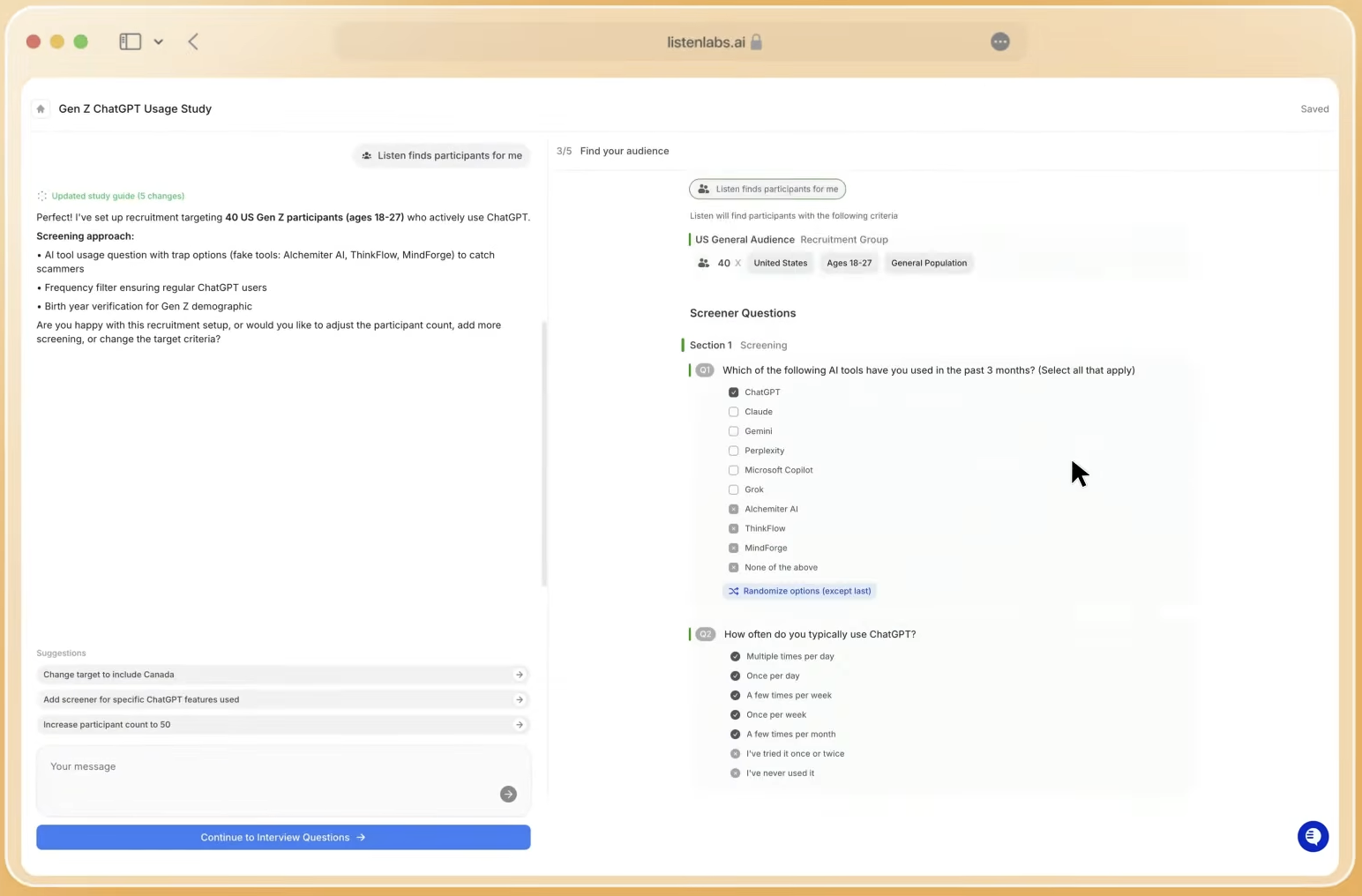
5. Interpretation and Coding Bias During Analysis
Interpretation bias emerges during qualitative data analysis when researchers’ subjective perspectives influence how they code, categorize, and synthesize findings. Different analysts may extract contradictory themes from identical interview transcripts based on their backgrounds and analytical frameworks.
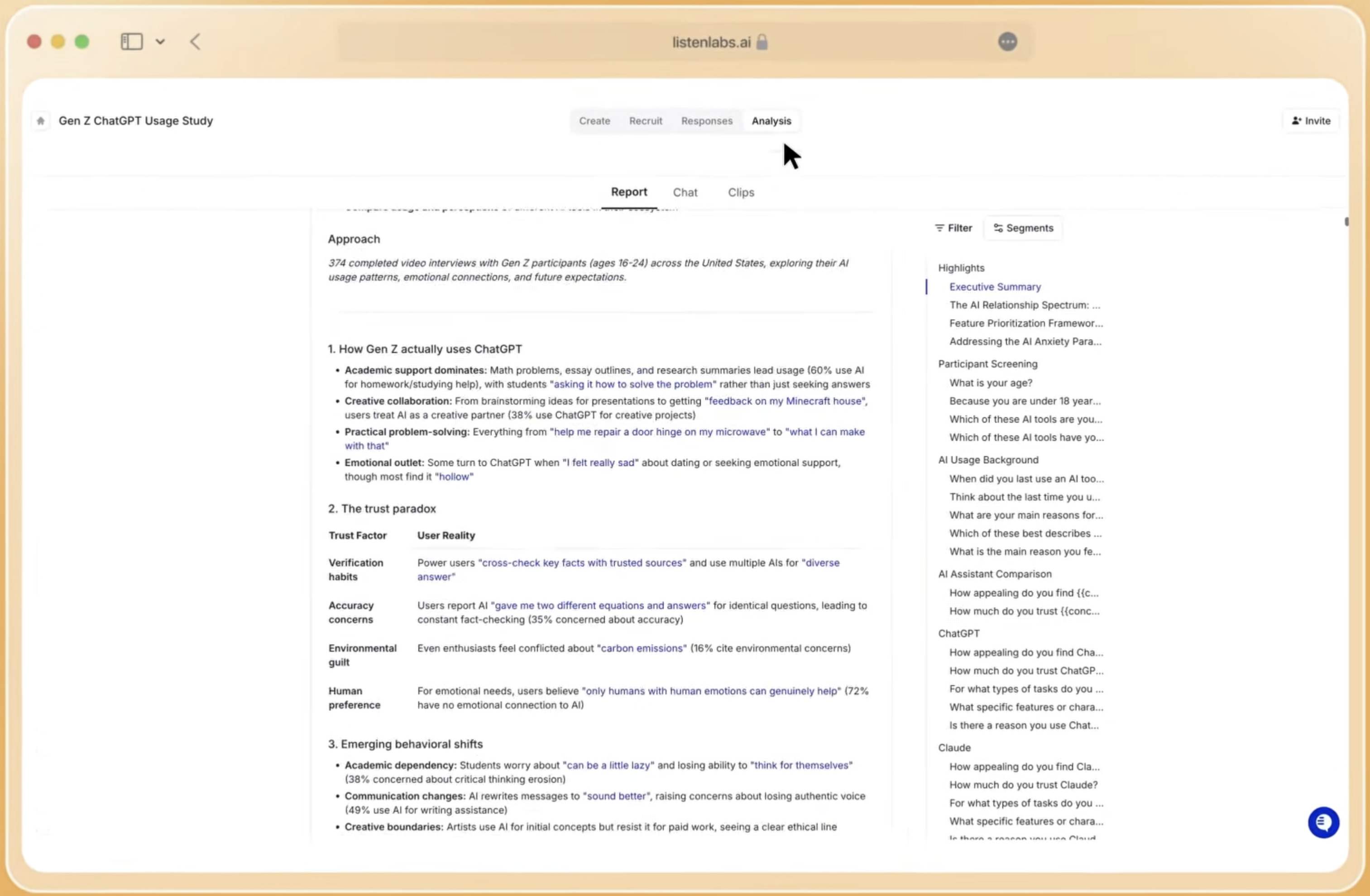
Multiple independent coders and inter-rater reliability checks traditionally address interpretation bias. Listen Labs’ Emotional Intelligence analyzes tone, word choice, and micro-expressions using standardized frameworks, quantifies emotions with timestamp-level precision, and provides traceable reasoning for every analytical decision. This approach greatly reduces subjective interpretation in the coding process.
The table below summarizes how AI-powered solutions address the five most critical bias types compared to traditional mitigation strategies.
|
Bias Type |
Example |
Traditional Fix |
AI Mitigation via Listen Labs |
|---|---|---|---|
|
Observer/Researcher |
Researcher assumptions in product studies |
Triangulation, reflexivity |
Research Agent objective analysis |
|
Confirmation |
Ignoring negative feedback |
Member checking, negative case analysis |
Unbiased pattern identification across extensive data points |
|
Hawthorne/Response |
UX testing social desirability |
Structured protocols, indirect questions |
Quality Guard real-time monitoring |
|
Selection |
Non-representative samples in churn analysis |
Diverse recruitment, quota sampling |
Listen Atlas network matching |
|
Interpretation/Coding |
Cultural differences in coding interviews |
Multiple coders, inter-rater reliability |
Emotional Intelligence standardized analysis |
CASP frameworks provide structured approaches to bias assessment in qualitative studies.
6. Cultural Bias in Global Research Programs
Cultural bias occurs when researchers impose their own cultural assumptions, values, or interpretive frameworks on participants from different cultural backgrounds. This bias can affect question design, interaction styles, and interpretation of responses across diverse global populations.
Global product studies often suffer from cultural bias when Western researchers misinterpret collectivist communication styles as lack of engagement. Bias also appears when individualistic frameworks are applied to analyze community-oriented consumer behaviors in Asian markets.
Cultural competency training and local research partnerships traditionally address cultural bias. Listen Labs supports 90+ languages with culturally adapted AI moderation and Listen Atlas recruitment across 45+ countries. This combination helps deliver authentic cross-cultural insights without imposing Western analytical frameworks on diverse global populations.
7. Interviewer Bias from Inconsistent Moderation
Interviewer bias emerges when moderators unconsciously influence participant responses through leading questions, non-verbal cues, or differential treatment based on participant characteristics. Inconsistent moderation styles across interviews can systematically skew findings.
Traditional research often suffers from interviewer bias when different moderators emphasize different aspects of the same study guide. These differences create incomparable data across interview sessions and can produce contradictory insights.
Standardized interview scripts and moderator training help reduce interviewer bias. Listen Labs’ AI-moderated interviews maintain completely consistent interaction styles across thousands of simultaneous sessions and remove human moderator variability while still using adaptive follow-up questions for conversational depth.
8. Funding Bias in Sponsored Research
Funding bias occurs when research sponsors influence study design, data collection, or interpretation to favor predetermined outcomes. This bias can be subtle and often affects question framing or emphasis rather than outright data manipulation.
Corporate-sponsored research may unconsciously frame questions to elicit positive responses about company products or services. Academic studies funded by industry groups might emphasize findings that support sponsor interests.
Transparent funding disclosure and independent oversight traditionally address funding bias. Listen Labs’ objective AI analysis engine processes all data using consistent algorithms regardless of study sponsor, which helps ensure that analytical outcomes reflect participant responses rather than sponsor preferences or expectations.
9. Recency Bias in Longitudinal Qualitative Work
Recency bias involves giving disproportionate weight to recently collected information while undervaluing earlier data points. This bias particularly affects longitudinal studies or research conducted over extended periods.
Market research teams often fall victim to recency bias when final interview sessions disproportionately influence their conclusions. Recent participants with strong opinions can overshadow earlier, more moderate responses.
Systematic data audit trails and temporal analysis help counter recency bias. Listen Labs processes entire datasets simultaneously rather than sequentially, which gives equal analytical weight to all participant responses regardless of collection timing and provides transparent audit trails for every analytical decision.
How to Avoid Bias in Qualitative Research Analysis
Effective bias mitigation requires systematic approaches across study design, data collection, and analysis phases. Traditional strategies include diverse research teams, peer review processes, and methodological triangulation, yet these approaches remain vulnerable to human subjectivity and resource constraints.
AI-powered platforms represent a step change in bias reduction. Listen Labs delivers actionable insights from in-depth interviews in hours, not weeks with zero human subjectivity. By removing human interpretation from the analysis process, this approach delivers statistical confidence usually associated with quantitative research while preserving the rich, contextual insights of qualitative methods.
The platform’s end-to-end approach targets bias introduction points that appear throughout traditional research workflows. From AI-assisted study design through automated participant matching and objective analysis, every step reduces human bias while maintaining methodological rigor that exceeds manual processes.
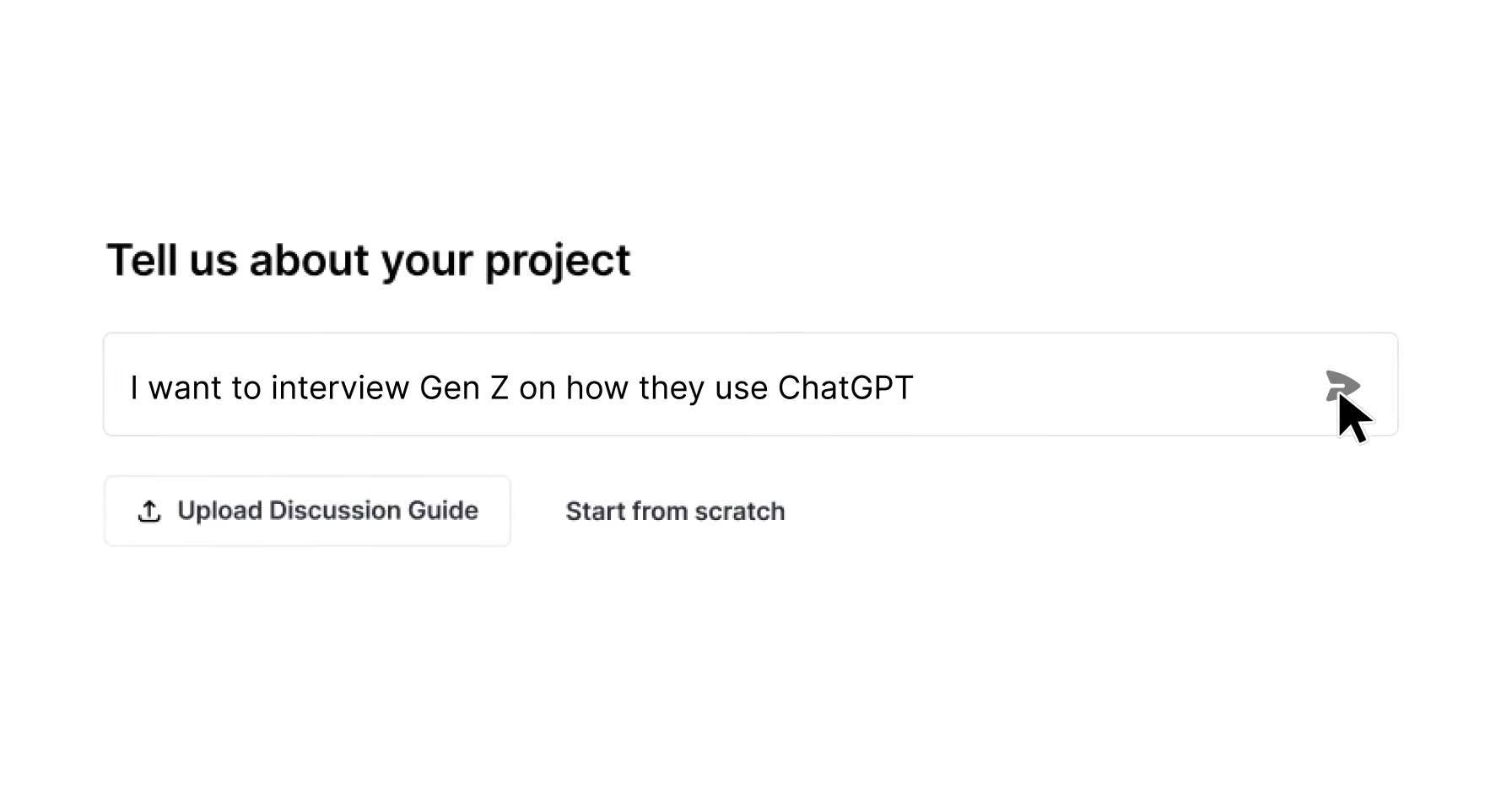
See firsthand how AI eliminates the nine bias types from your research workflow and request your personalized demonstration of bias-free analysis.
Why Listen Labs Excels at Eliminating Qualitative Research Bias
Listen Labs’ comprehensive approach to bias reduction spans the entire research lifecycle. The 30-million-person Listen Atlas panel supports representative sampling across almost any demographic or psychographic segment, while Quality Guard monitors every interview for fraud, low-effort responses, and behavioral inconsistencies in real time.
Emotional Intelligence captures nuanced participant responses through tone analysis, word choice patterns, and micro-expression detection. These capabilities provide objective emotional data that human observers might miss or misinterpret. The Research Agent then generates traceable insights with timestamp-level precision so every analytical decision can be verified and validated.
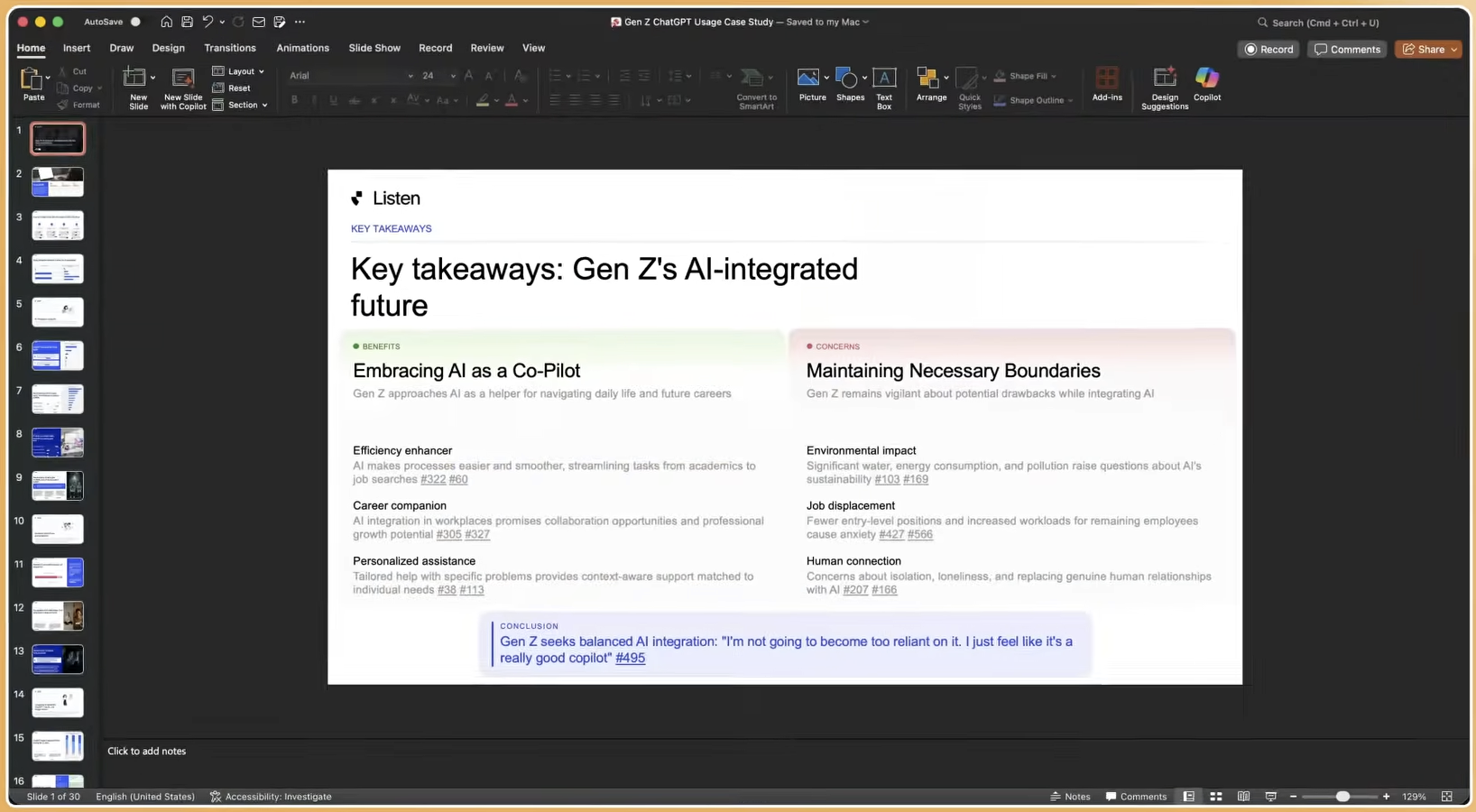
Enterprise case studies show measurable bias reduction through objective AI analysis. These outcomes stem from Listen Labs’ core advantage: processing massive datasets objectively instead of relying on human interpretation that is prone to systematic errors.
Compared to traditional tools, Listen Labs provides fraud-proof quality that surpasses UserTesting’s human-dependent model or Dovetail’s analysis-only capabilities.
Frequently Asked Questions
What are the main types of bias in qualitative research?
The nine most common types include observer or researcher bias, confirmation bias, Hawthorne or response bias, selection bias, interpretation or coding bias, cultural bias, interviewer bias, funding bias, and recency bias. Each type affects different aspects of the research process, from study design through final analysis, and can significantly impact the validity and reliability of findings.
How does AI reduce confirmation bias in qualitative research analysis?
AI reduces confirmation bias by processing all interview data without predetermined hypotheses or expectations. Listen Labs’ Research Agent analyzes patterns across millions of data points objectively and surfaces unexpected insights that human analysts might dismiss. The system identifies themes based on actual participant responses rather than researcher expectations, which supports comprehensive analysis of both supporting and contradictory evidence.
Can Listen Labs handle cultural bias in global studies?
Listen Labs addresses cultural bias through a global infrastructure that combines localized AI moderation and recruitment capabilities. The platform’s Emotional Intelligence recognizes cultural variations in expression and communication styles, while standardized analytical frameworks prevent Western-centric interpretation of diverse global responses. This approach supports authentic cross-cultural insights without imposing cultural assumptions.
What are the key differences between Listen Labs and traditional research tools?
Traditional tools often require multiple vendors for recruitment, moderation, and analysis, which introduces bias at each handoff point. Listen Labs provides end-to-end bias reduction through integrated AI systems that maintain consistency across the entire research lifecycle. The platform also provides objective analysis that removes human subjectivity from interpretation.
How can I get started with bias-free qualitative research analysis?
Begin by identifying which types of bias most commonly affect your current research processes, then evaluate how AI-powered solutions can address these specific challenges. Listen Labs offers comprehensive bias reduction across all nine common bias types while delivering enterprise-grade insights at meaningful speed and scale.
Eliminate Bias in Qualitative Research with Listen Labs
The nine common types of bias in qualitative research analysis represent systematic threats to research validity that traditional methods struggle to address comprehensively. AI-powered platforms like Listen Labs reduce these biases through objective analysis, consistent moderation, and representative sampling at scale.
Start eliminating all nine bias types from your research process and schedule your demonstration to see AI-powered analysis in action, plus receive a complimentary ‘Qualitative Bias Checklist PDF’ to audit your current research processes.