

Written by: Anish Rao, Head of Growth, Listen Labs
Key Takeaways
- Enterprise user research teams can compress 4–6 week cycles to under 24 hours using AI-powered platforms like Listen Labs that deliver qualitative research at scale.
- Listen Labs leads with a 30M+ verified global panel, AI-moderated interviews that capture emotional intelligence, and automated analysis that outputs stakeholder-ready deliverables.
- Competitors such as UserTesting face human moderation delays, Maze focuses on quantitative prototype testing, and recruitment-only platforms like Prolific create fragmented workflows.
- Key enterprise criteria include end-to-end workflows, panel scale and quality, speed to insight, AI depth, security compliance, integration with existing tools, enterprise case studies, and proven Fortune 500 ROI.
- Fortune 500 teams like Microsoft and P&G achieve 10x research output with Listen Labs; see how Listen Labs delivers qual-at-scale in under 24 hours.
Enterprise Criteria for Product Testing Platforms
Enterprise user research teams require platforms that meet eight critical criteria, and each one removes a specific bottleneck in traditional research. End-to-end workflow capabilities reduce vendor fragmentation by handling recruitment, moderation, analysis, and reporting in a single system. This integration supports faster speed to insight, so teams move from study brief to actionable results without coordinating multiple tools.
Panel scale and quality determine whether platforms can reach niche audiences across global markets with verified participants at this accelerated pace. AI depth then decides whether platforms capture emotional intelligence and behavioral signals beyond basic transcription. Security compliance ensures SOC 2, GDPR, and ISO certifications meet enterprise standards for data protection.
Integration capabilities connect with existing workflows through Jira, Figma, and enterprise SSO, which keeps research aligned with product and design teams. Enterprise case studies demonstrate proven performance at Fortune 500 scale, while ROI metrics quantify cost savings and output gains compared to traditional research approaches. Together, these criteria define whether a platform can support modern enterprise research demands.
Current market leaders like UserTesting rely on human-dependent moderation that creates speed bottlenecks. Quantitative-focused platforms like Maze trade qualitative depth for scale. The gap exists for platforms that deliver both conversational depth and statistical confidence through AI-native architectures, and Listen Labs fills this gap with an end-to-end AI approach.
1. Listen Labs: AI-Native Qualitative Research at Enterprise Scale
Listen Labs leads the enterprise category by delivering complete research cycles from brief to stakeholder presentation in a single day through its AI-native platform. The platform combines a 30M+ verified participant network across 45+ countries and 100+ languages with AI-moderated interviews that capture verbal responses and emotional intelligence through tone, word choice, and micro-expressions.
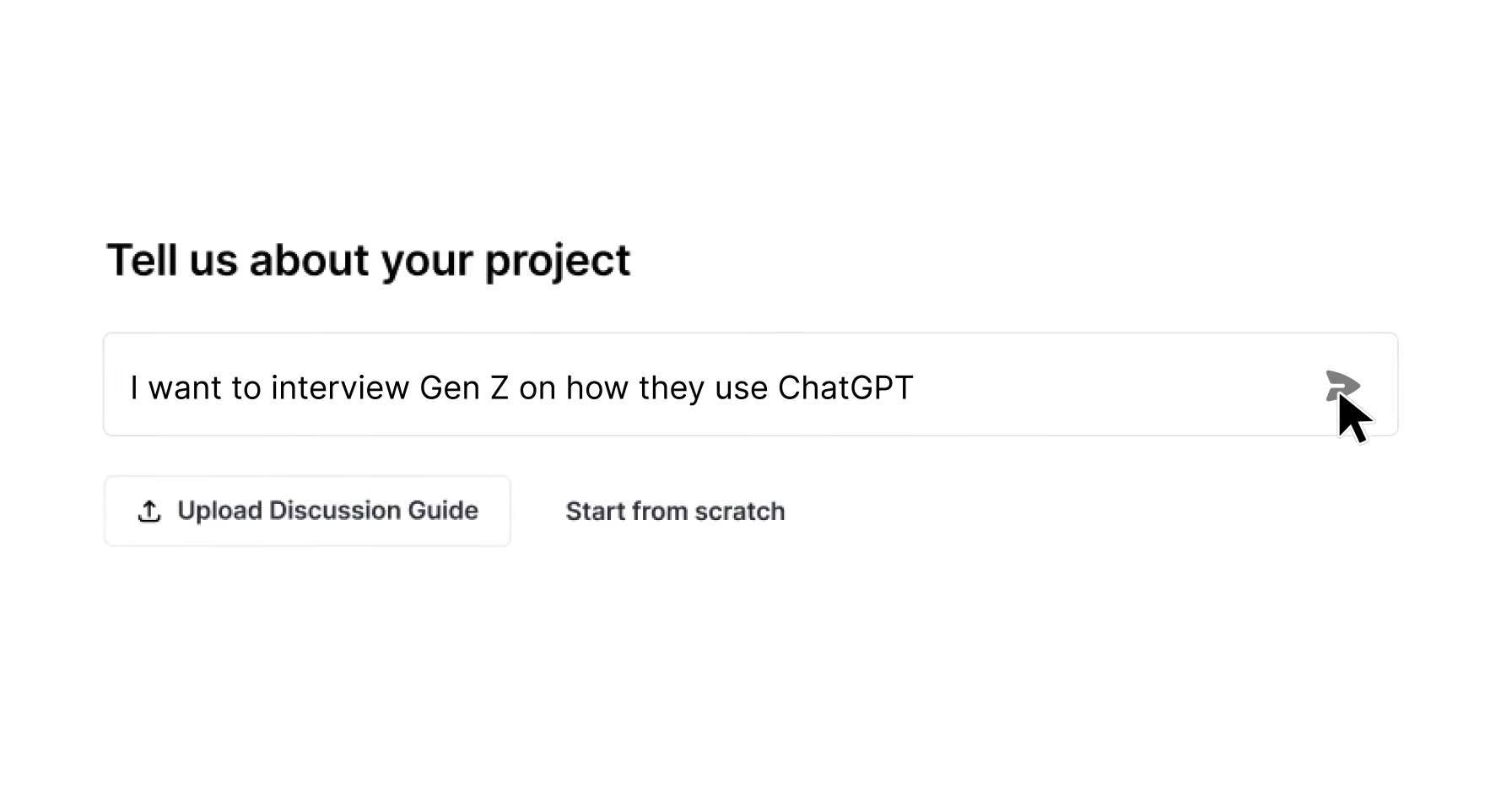
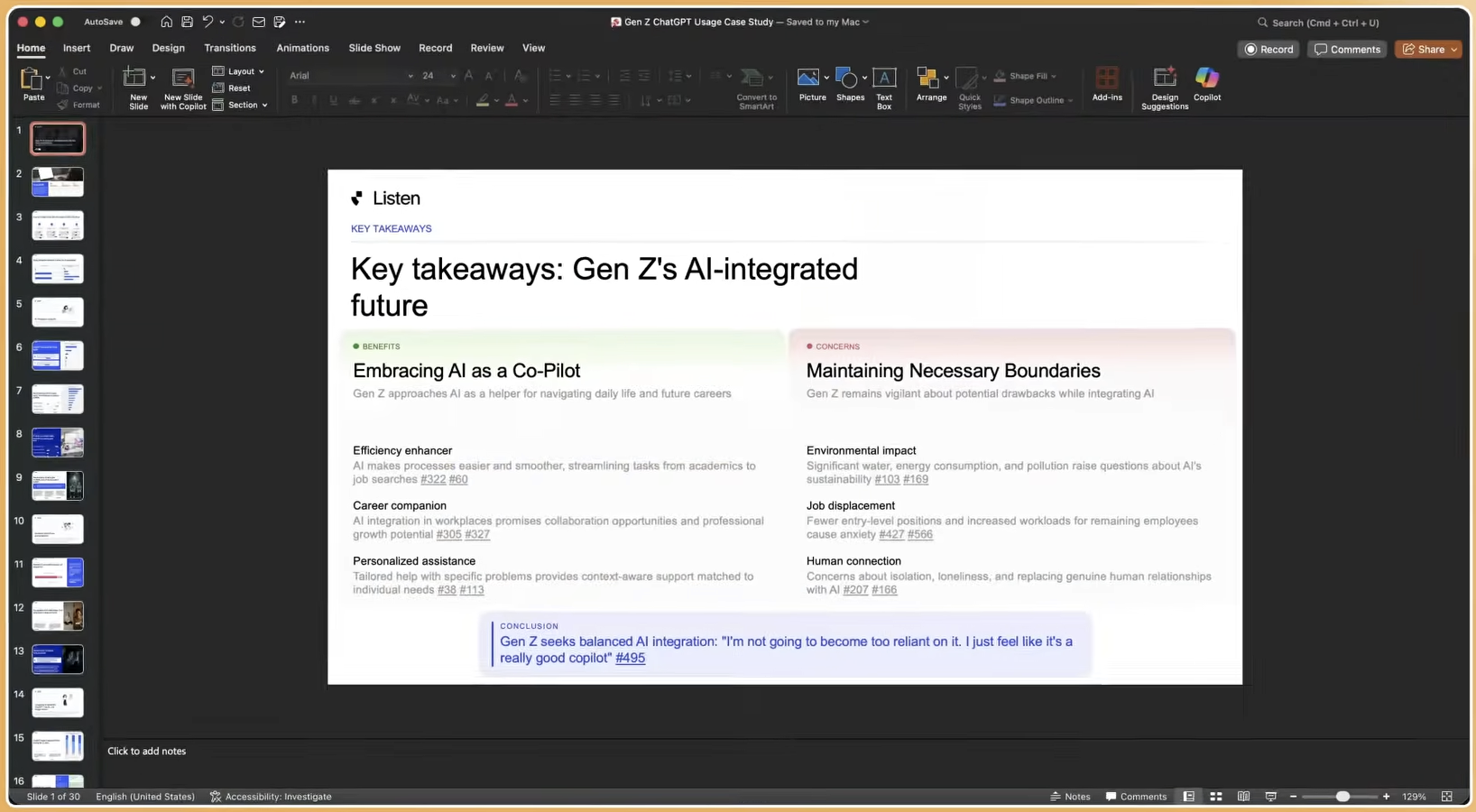
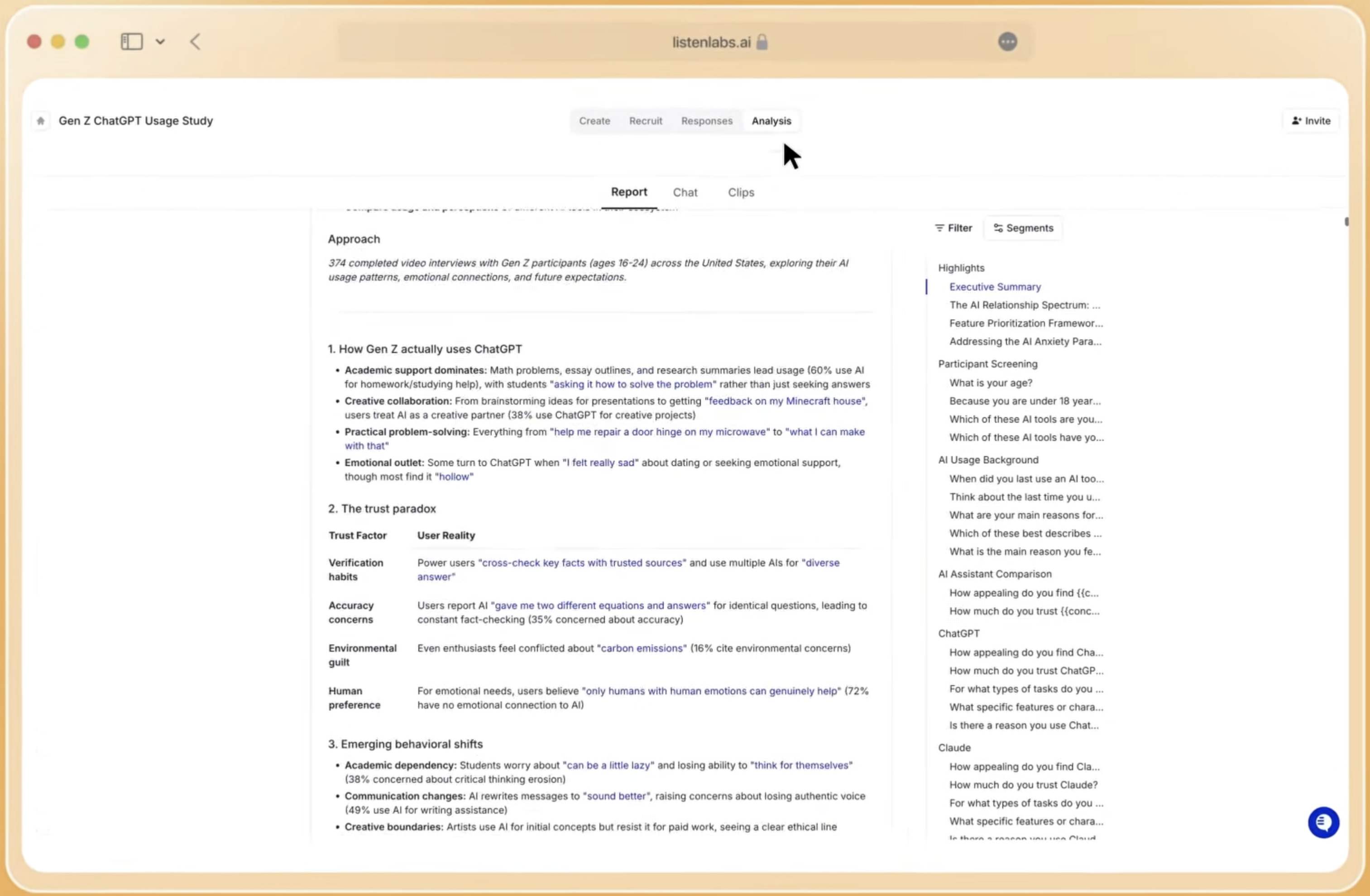
The platform’s Research Agent handles the full analysis workflow from raw data to stakeholder-ready deliverables. It generates branded slide decks, statistical comparisons, and video highlight reels in under a minute. Quality Guard provides real-time fraud detection and participant verification, and Listen Atlas orchestrates recruitment across multiple panel sources with behavioral matching that goes beyond demographics.
Microsoft reduced research cycles from weeks to hours by using Listen Labs to collect global customer stories for their 50th anniversary celebration within a day. Anthropic conducted more than 300 user interviews in 48 hours to understand Claude subscription churn. P&G validated product claims with over 250 interviews that shaped brand strategy before market launch.
Pros: Fastest time-to-insight, largest verified panel, AI emotional intelligence, enterprise security (SOC 2, ISO 27001), proven Fortune 500 ROI. Cons: Requires a demo for companies with more than 100 employees. Pricing: Subscription plus credits per participant. Best for: VPs of Consumer Insights who need to clear research backlogs and support more product decisions.
See how Listen Labs delivers qual-at-scale in under 24 hours.
2. UserTesting: Human-Moderated Video Feedback
UserTesting provides video-based user feedback through a global participant network with human moderation. The platform supports usability testing, prototype validation, and concept testing with screen recording capabilities. UserTesting’s strength lies in its established enterprise relationships and comprehensive video feedback capture.
Pros: Established global panel, comprehensive video feedback, enterprise integrations. Cons: Human-dependent moderation creates week-long delays, limited AI analysis depth, higher cost per insight. Pricing: Enterprise tier pricing varies by volume. Best for: Teams that prioritize rich video feedback over speed.
3. Maze: Rapid Quantitative Prototype Testing
Maze specializes in rapid prototype testing with strong Figma integration for design teams. The platform excels at quantitative usability metrics such as click tracking, heatmaps, and conversion funnels. Maze’s strength is in design validation workflows for UX teams that need quick directional data.
Pros: Seamless Figma integration, rapid quantitative insights, design-focused workflows. Cons: Limited qualitative depth, no conversational interviews, restricted to prototype testing. Pricing: Team and Enterprise tiers. Best for: UX teams validating design prototypes before development.
4. Qualtrics: Enterprise-Grade Survey and Analytics Suite
Qualtrics offers comprehensive survey capabilities with enterprise integrations and advanced analytics. The platform provides robust quantitative research tools with some qualitative features through open-ended responses and basic text analysis. It fits organizations that already center their research around structured surveys.
Pros: Enterprise integrations, advanced survey logic, comprehensive analytics dashboard. Cons: Limited qualitative depth, slower qualitative capabilities at scale, complex setup requirements. Pricing: Custom enterprise pricing. Best for: Teams with heavy quantitative research needs and existing survey programs.
Compare Listen Labs’ AI capabilities against your current research stack.
5. Prolific: High-Quality Participant Recruitment
Prolific provides high-quality participant recruitment with academic-grade screening and verification. The platform focuses on participant sourcing rather than end-to-end research workflows, so teams must connect it with separate interview and analysis tools. This structure works well for researchers who already have a preferred tool stack.
Pros: High participant quality, academic verification standards, diverse global reach. Cons: Recruitment-only platform, requires separate moderation and analysis tools, fragmented workflow. Pricing: Per-participant fees. Best for: Teams that primarily need verified participant sourcing.
6. Respondent: B2B and Professional Audience Access
Respondent specializes in B2B participant recruitment with targeting capabilities for enterprise decision-makers and niche professional audiences. The platform provides recruitment services but relies on external tools for interview moderation and analysis. It suits teams that focus on expert or professional interviews.
Pros: Strong B2B targeting, access to enterprise decision-makers, professional audience verification. Cons: Fragmented workflow requiring multiple tools, limited to recruitment, higher cost per participant. Pricing: Credit-based system. Best for: Teams researching niche professional audiences.
7. Dovetail: Central Repository for Qualitative Insights
Dovetail functions as a research repository and analysis platform for organizing and analyzing qualitative data from external sources. The platform excels at post-research organization and cross-study insights but does not conduct primary research. It helps teams create a single source of truth for past studies.
Pros: Comprehensive research repository, cross-study analysis, team collaboration features. Cons: No participant recruitment or interview capabilities, requires external research tools, limited to analysis. Pricing: Team and Enterprise subscriptions. Best for: Teams organizing and mining existing research data.
8. SurveyMonkey: Accessible Quantitative Survey Tool
SurveyMonkey provides accessible survey creation and basic analytics for quantitative research. The platform offers affordable entry-level research capabilities with limited qualitative features. It often serves as a starting point for teams new to structured research.
Pros: Affordable pricing, easy survey creation, basic analytics included. Cons: No qualitative depth, limited AI capabilities, basic participant targeting. Pricing: Basic and Pro tiers. Best for: Teams conducting simple quantitative surveys.
Enterprise Comparison Matrix
The table below shows how Listen Labs’ end-to-end AI architecture delivers faster, deeper insights than competitors that rely on human moderation or focus on narrow research phases.
| Platform | End-to-End Workflow | Panel Size | Time-to-Insight | AI Emotional Intelligence |
|---|---|---|---|---|
| Listen Labs | ✓ Complete | 30M+ verified | <24 hours | ✓ Full spectrum |
| UserTesting | ✓ Complete | 2M+ global | 1–2 weeks | ✗ Limited |
| Maze | ✗ Design-only | Panel partners | Hours–days | ✗ None |
| Qualtrics | ✗ Survey-focused | Panel partners | Days–weeks | ✗ Basic sentiment |
These capability differences translate directly into the workflow improvements enterprise teams report in practice.
What Enterprise Teams Say
Enterprise research teams consistently report that traditional research backlogs are “killing agility” and blocking rapid product iteration. Industry analysis shows that enterprise teams prioritize platforms that can predict in-market performance through behavioral testing rather than basic feedback collection.
Microsoft’s Director of Data Science noted that Listen Labs enabled their team to “reach out to hundreds of users at one third of the cost” while delivering results “within a day” compared to traditional week-long cycles. P&G’s Analytics and Insight Leader shared that Listen Labs “has been a huge help” in validating product claims before market launch.
Together, these stories highlight how AI-native platforms change both the speed and the quality of enterprise decision-making.
FAQ
How does AI moderation compare to human interviewer quality?
AI moderation through platforms like Listen Labs maintains methodological rigor equivalent to trained human researchers while delivering superior consistency and scale. The AI conducts adaptive conversations with dynamic follow-up questions and captures emotional intelligence through tone analysis and micro-expressions that human moderators often miss. Every insight links directly to underlying response data for full traceability, which reduces subjective interpretation bias common in human analysis.
Can these platforms reach niche enterprise audiences?
Leading platforms like Listen Labs can recruit audiences below 1% incidence rate through dedicated recruitment operations teams and specialized panel partnerships. This reach includes enterprise decision-makers, healthcare workers, engineers, and highly specific consumer segments across more than 45 countries. Quality verification ensures authentic participants rather than professional survey-takers.
What security standards do enterprise platforms meet?
Enterprise-grade platforms maintain SOC 2 Type II, GDPR, ISO 27001, ISO 27701, and ISO 42001 certifications with 256-bit encryption. Customer data remains isolated and is never used for AI model training. Single sign-on integration and role-based access controls align with Fortune 500 security requirements.
How does pricing compare between platforms?
Subscription models with credit-based participant fees are standard, with costs varying by audience difficulty. General population studies require fewer credits than niche professional audiences. Enterprise teams typically achieve one-third the cost of traditional research approaches while multiplying output volume through AI automation and parallel interview capabilities.
Can teams integrate their own participant databases?
Most enterprise platforms support bring-your-own-participant options at reduced credit costs, which allows teams to study existing user bases while using platform capabilities for moderation, analysis, and reporting. This hybrid approach maximizes ROI while maintaining research quality standards.
Listen Labs dominates the 2026 enterprise landscape by removing the traditional trade-off between research depth and scale through AI-native qualitative capabilities at scale. The top three platforms for enterprise teams are Listen Labs for comprehensive end-to-end workflows, UserTesting for established video feedback, and Maze for rapid design validation. Launch a pilot to eliminate your research backlog and experience the speed improvements described above.