

Written by: Anish Rao, Head of Growth, Listen Labs
Key Takeaways
- Enterprise AI research platforms compress traditional 4–6 week research cycles into hours, and 66% of organizations report productivity gains from AI adoption.
- Listen Labs ranks #1 for deep customer research, running thousands of AI-moderated interviews across a 30M+ global panel in under 24 hours with Emotional AI analysis.
- Top platforms specialize in internal search (Glean), custom agents (Vellum), data analysis (Tellius), and UX testing (UserTesting), but few deliver qualitative depth at enterprise scale.
- Enterprise-ready security includes SOC 2, GDPR, 256-bit encryption, RBAC, and fraud detection to protect data integrity and compliance.
- 2026 trends center on agentic workflows and Emotional AI; book a Listen Labs demo to scale customer insights up to 10x faster.
Best Enterprise AI Research Assistant Platforms in 2026
1. Glean for Internal Knowledge Search
Glean connects to Google Workspace, Slack, Jira, and Salesforce to power unified enterprise search across documents, conversations, and internal data. The platform uses AI to surface relevant information, summarize documents, and answer questions based on company knowledge. Glean excels at knowledge retrieval and internal productivity but does not support customer research.
Pros: Deep enterprise integrations, unified search, document summarization
Cons: Limited to internal data, no customer interview capabilities
Best for: Internal knowledge management and productivity
2. Vellum AI for Custom Agent Development
Vellum AI provides enterprise-grade security including RBAC, SSO, SCIM, approval workflows, and compliance support for SOC 2, GDPR, and HIPAA. The platform offers a no-code Agent Builder using natural language prompts, multi-model support including BYOM, and flexible deployment options across cloud and on-premises environments.
Pros: No-code agent building, enterprise security, flexible deployment
Cons: Requires technical setup, limited research-specific features
Pricing: Free tier available, Pro from $500/month, custom enterprise pricing
Best for: Technical teams building custom AI automation workflows
3. Sana Labs Onyx for Semantic Search
Sana Labs Onyx delivers semantic search across enterprise knowledge bases with AI-powered content discovery and retrieval. The platform focuses on making organizational knowledge more accessible through intelligent search and summarization.
Pros: Advanced semantic search, knowledge discovery
Cons: Limited analysis capabilities, no customer research features
Best for: Organizations prioritizing knowledge management and search
4. Tellius for AI-Driven Data Analysis
Tellius combines governed NL-to-SQL conversational analytics across 30+ sources including Snowflake, Databricks, BigQuery, and CRMs, with autonomous root cause investigation and proactive KPI monitoring. Case studies show Novo Nordisk reduced analysis time by 88% and Regeneron by 97%.
Pros: Advanced data analysis, autonomous investigation, SOC 2 compliance
Cons: Focused on quantitative data, limited qualitative research support
Best for: Data-heavy organizations needing automated analytics
5. Moveworks for IT Service Automation
Moveworks focuses on IT service automation, using AI to resolve employee requests, automate workflows, and provide self-service capabilities across IT and HR. The platform integrates with enterprise IT systems to streamline operations and reduce ticket volume.
Pros: Strong IT automation, workflow integration
Cons: Primarily IT-focused, no research capabilities
Best for: IT departments seeking automation and efficiency
6. Perplexity Enterprise for Cited Secondary Research
Perplexity Enterprise focuses on source-backed output, answer retrieval from internal and external sources, and fresh information for analysts, researchers, consultants, and executives. The platform provides cited, structured answers with source visibility and supports follow-up exploration.
Pros: Source citations, research focus, fresh information access
Cons: Primarily secondary research focus, limited primary data collection
Best for: Research teams needing cited secondary research and competitive analysis
7. Kore.ai for Conversational Automation
Kore.ai offers conversational AI platforms for deploying virtual assistants in customer service, HR, finance, and operations. The platform automates processes by interacting with employees, processing requests, and triggering workflows across enterprise systems.
Pros: Conversational interfaces, workflow automation
Cons: Limited research applications, focused on operational tasks
Best for: Organizations seeking conversational automation across departments
8. Hebbia for Document Intelligence
Hebbia builds AI agents that automate complex knowledge work, enabling analysts, legal teams, and financial professionals to analyze large datasets, documents, and diverse data sources to extract insights. The platform excels in document-heavy workflows.
Pros: Document analysis, knowledge extraction, complex reasoning
Cons: Focused on document workflows, no customer interview capabilities
Best for: Finance, legal, and analytical teams processing large document volumes
9. UserTesting for UX and CX Research
UserTesting provides on-demand access to a global panel of participants for product, design, marketing, and CX teams, featuring built-in AI-powered analytics that automatically summarize feedback, identify sentiment, and highlight key themes. The platform still relies on human-dependent moderation, which slows turnaround times.
Pros: Established UX focus, video analysis, global panel
Cons: Human-dependent moderation, slower cycles, limited conversational depth
Best for: UX teams with traditional research workflows
10. Listen Labs for Deep Qualitative Customer Research
Listen Labs is an end-to-end AI research platform that sources participants from a 30M+ verified network across 45+ countries and 100+ languages. It conducts, analyzes, and summarizes thousands of in-depth customer interviews in hours, not weeks. The platform removes the usual trade-off between depth and scale through AI-moderated interviews, Emotional Intelligence analysis, and automated deliverable generation.
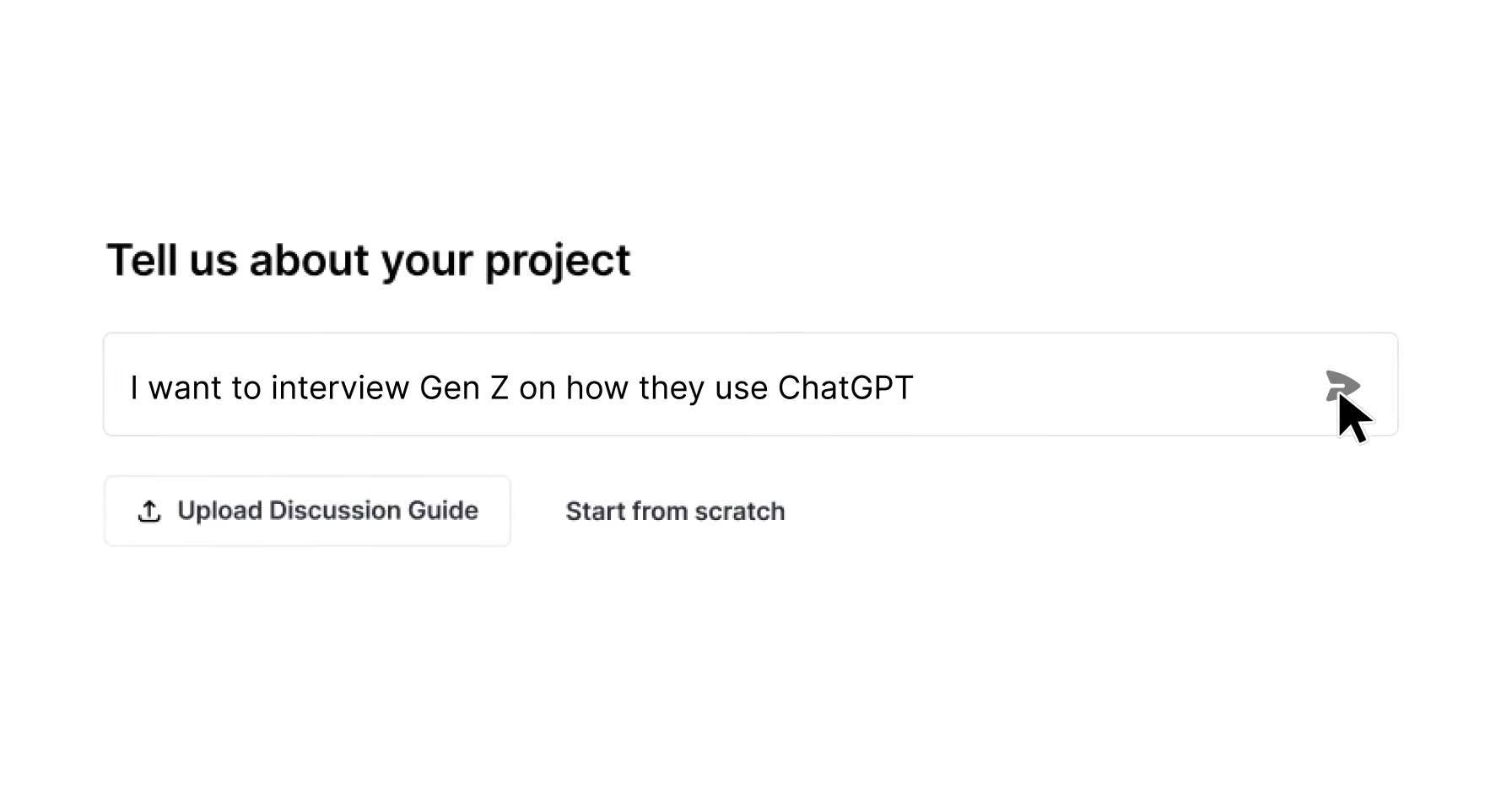
Key capabilities include:
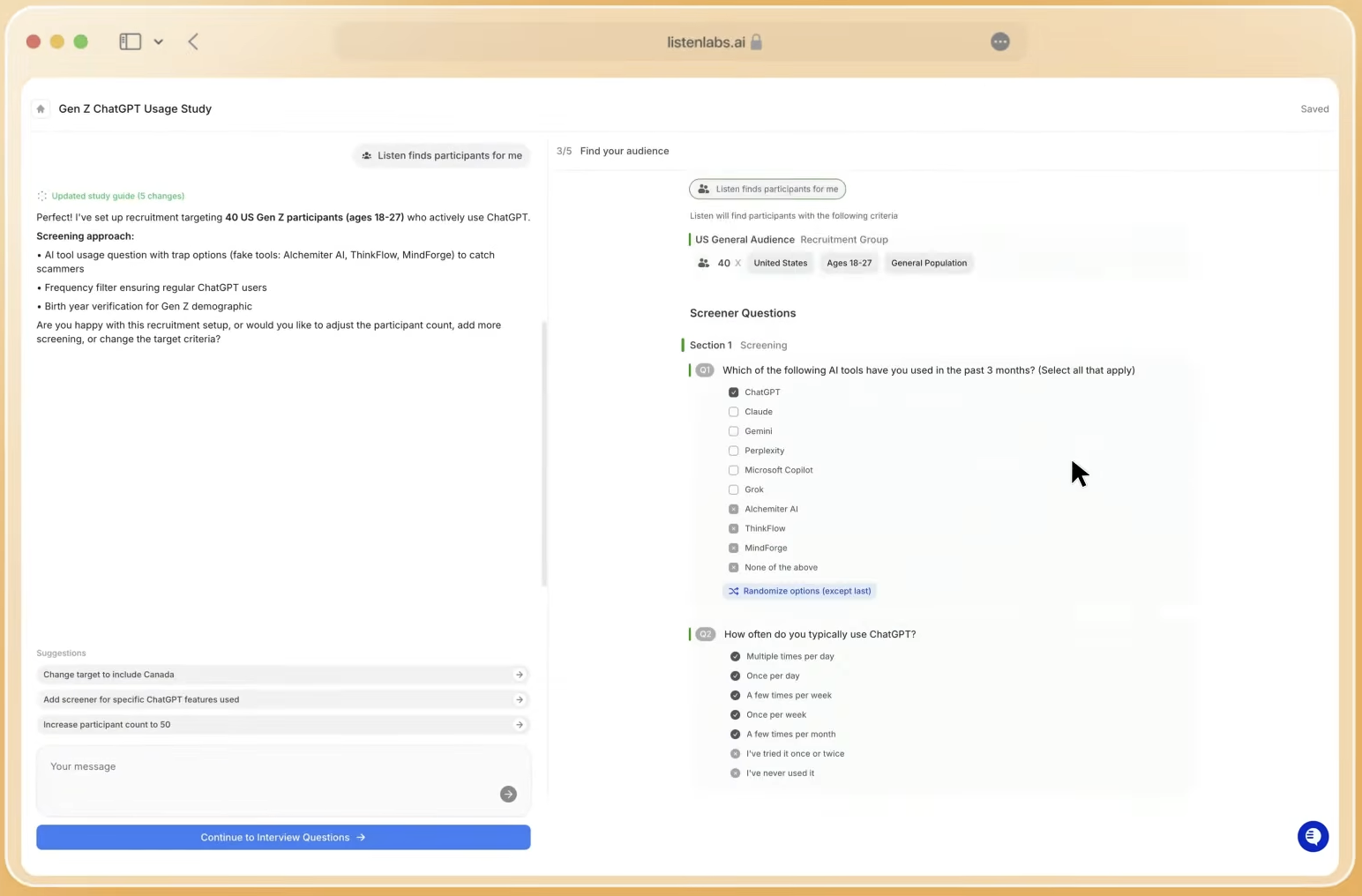
- Listen Atlas: Global recruitment with AI orchestration and Quality Guard fraud detection
- AI-Moderated Interviews: Dynamic follow-up questions and rich response capture
- Emotional Intelligence: Multimodal signal analysis built on Ekman’s universal emotions framework
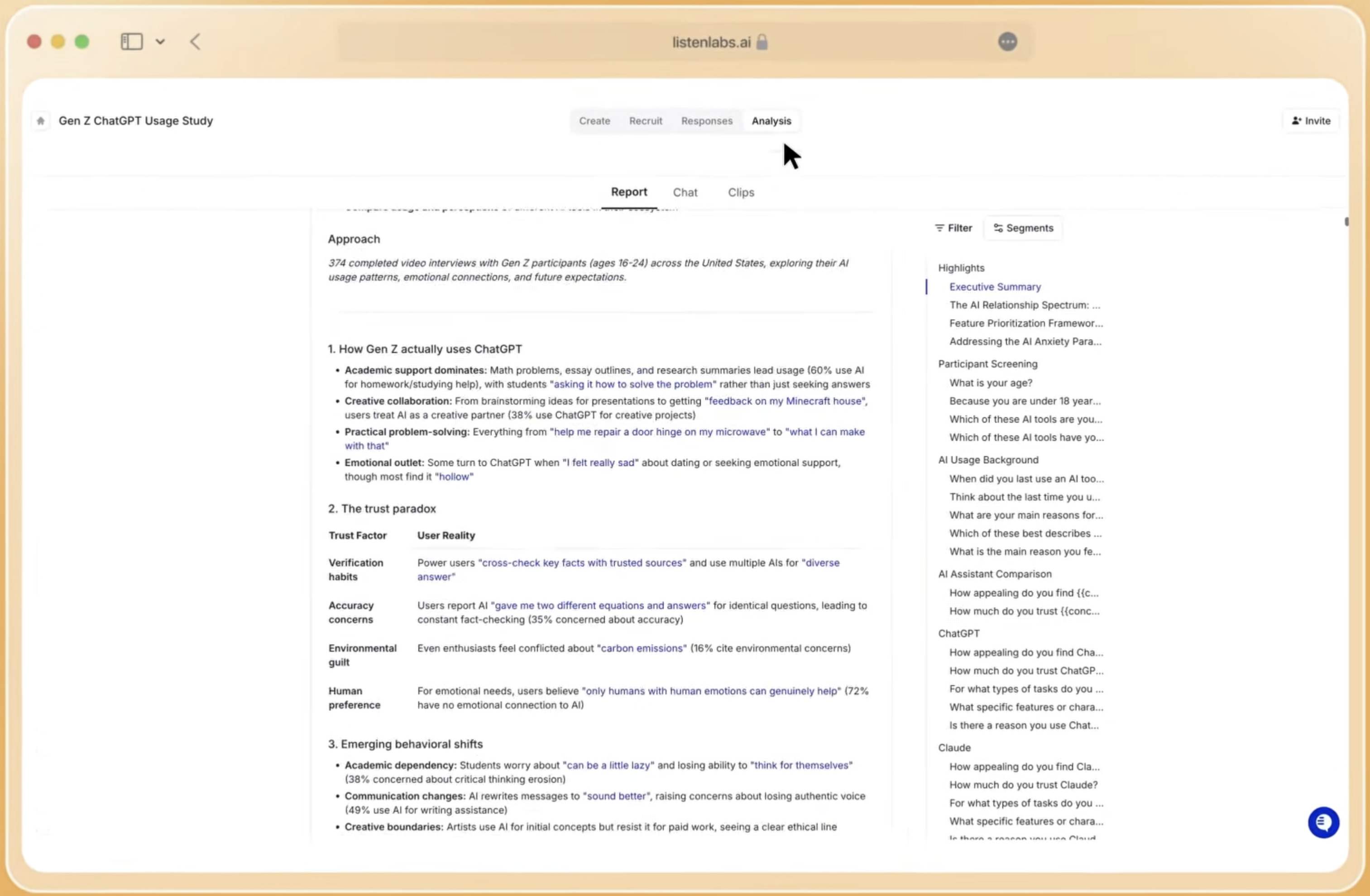
- Research Agent: Automated analysis generating slide decks, reports, and highlight reels
- Mission Control: Cross-study intelligence and institutional knowledge building
Enterprise case studies:
- Microsoft: Cut research wait time from weeks to hours and collected global customer stories within a day for their 50th anniversary celebration.
- Anthropic: Completed 300+ user interviews in 48 hours, surfaced churn drivers 5x faster, identified where Claude users migrate, and prioritized must-fix items.
- P&G: Ran 250+ interviews with quantified themes that focused innovation on real pain points before market launch.
- Skims: Validated thousands of high-income buyers overnight to de-risk a global campaign launch.
Pros: End-to-end platform, 24-hour cycles, large global panel, Emotional AI, enterprise security
Cons: Newer platform compared to traditional research vendors
Best for: Enterprise insights teams needing qualitative research at scale
Quick Comparison: Features, Pricing, ROI
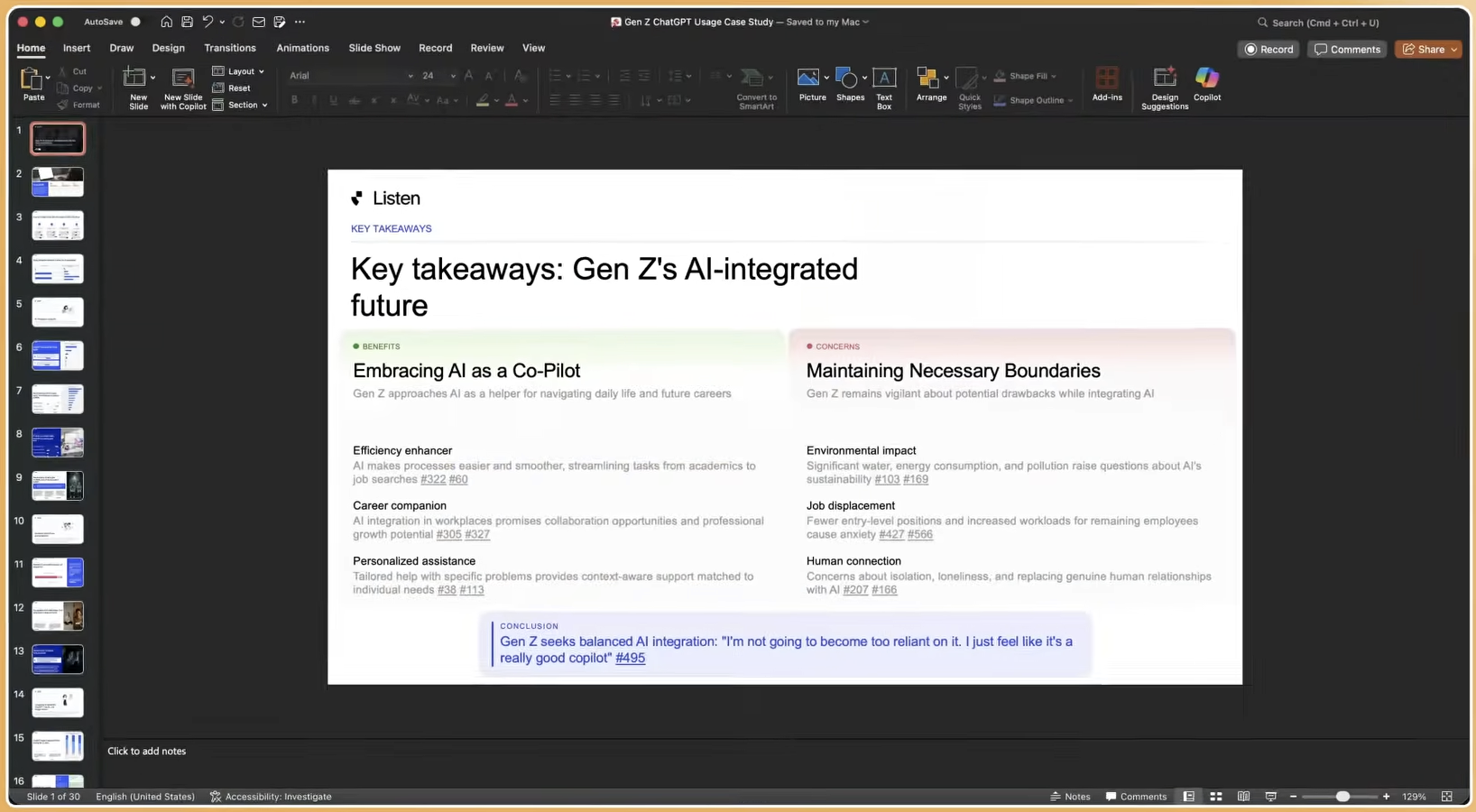
The table below shows how Listen Labs compares to other platforms on speed to insights, access to participants and Emotional AI, and cost efficiency for enterprise teams.
| Platform | Time to Insights | Panel Size/Emotional AI | Cost Savings/Enterprise Clients |
|---|---|---|---|
| Listen Labs | <24 hours | 30M+ panel + Emotional AI | 1/3 cost vs traditional / Microsoft, P&G |
| UserTesting | Days (with Instant Insights) | Limited panel / Basic sentiment | Standard pricing / Mixed enterprise |
| Vellum AI | Setup dependent | No panel / Custom agents | From $500/month / Technical teams |
| Tellius | Real-time queries | No panel / Data analysis only | Enterprise quotes / Novo Nordisk |
Scaling Qualitative Research Across the Enterprise
The platforms above vary in focus, but the highest-value options share one capability: qualitative research at scale. Qual-at-scale removes the traditional trade-off between depth and scale by using AI to automate recruiting, interviewing, and analysis. This approach lets enterprises run hundreds or thousands of qualitative interviews at once while still maintaining conversational depth through dynamic follow-up questions and adaptive conversations.
Leading Fortune 500 companies now use qual-at-scale to clear research backlogs that once required 4–6 week cycles. AI-led interviews outperform traditional focus groups by delivering faster, cheaper, and more unbiased insights through one-on-one sessions that avoid social biases like groupthink. Teams gain research that scales while still capturing the nuance needed for confident strategic decisions.
Security, Compliance, and Data Integrity
Enterprise AI research assistant platforms must protect sensitive customer data and proprietary insights at every step. Leading platforms provide SOC 2 Type II certification, GDPR compliance, and enterprise-grade features including:
- Data encryption: 256-bit encryption for data at rest and in transit
- Access controls: RBAC, SSO/SAML integration, and audit trails
- Deployment options: Cloud, private VPC, on-premises, and hybrid configurations
- Compliance frameworks: ISO 27001, HIPAA, and industry-specific requirements
Protecting enterprise data represents only one side of the security equation. Research platforms also need to guarantee the quality and authenticity of the data they collect. Quality assurance therefore extends beyond security to participant verification and fraud detection, with multi-layered protection that includes behavioral matching, real-time monitoring, and reputation scoring to preserve data integrity and research validity.
2026 Trends: Emotional AI and Agentic Workflows
Enterprise research teams now move toward agentic workflows where AI systems handle entire projects, not just isolated tasks. This shift aligns with Gartner’s earlier prediction that task-specific AI agents will become standard in enterprise software by the end of 2026. Agentic research workflows allow AI to operate autonomously across study design, participant recruitment, analysis, and reporting.
Emotional AI marks a major advance in understanding customer sentiment beyond transcripts alone. These systems analyze tone of voice, word choice, and micro-expressions to surface emotions that participants do not explicitly verbalize. Josh Bersin describes 2026 as “The Year of Enterprise AI” and outlines a progression from assistants to agents to full solutions, which reflects how Emotional AI and domain-specific agents now power complete research outcomes.
P&G’s recent use of Emotional AI in product testing showed that comfort, safety, and reliability matter far more than novelty for male consumers, and those findings shaped product strategy before launch. This level of quantified emotional insight, tied to specific interview moments, signals the future of customer research. See how Listen Labs multiplies your output by up to 10x with a pilot and experience these capabilities firsthand.
Enterprise AI Research Assistants FAQ
How does Listen Labs ensure participant quality and prevent fraud?
Listen Labs uses three layers of protection to maintain participant quality. First, the platform works only with high-quality, non-commodity panels, which removes professional survey-takers. Second, Quality Guard uses real-time AI monitoring across video, voice, content, and device signals to detect fraud, low-effort responses, AI-generated scripts, and mismatched profiles. Third, a dedicated recruitment operations team adds human review, and participants are limited to three studies per month to prevent panel fatigue and preserve engagement quality.
Can AI interviewers match the quality of trained human researchers?
Listen Labs applies the same methodological rigor as strong in-house research teams while improving the experience compared to under-resourced operations. The AI conducts personalized conversations with dynamic follow-up questions and probes deeper on interesting responses, similar to trained human interviewers. With more than 50 years of combined research expertise built into the platform, the AI delivers comparable quality at far greater speed and scale, which lets research teams focus on strategic analysis instead of logistics.
What types of studies can enterprise AI research assistant platforms support?
Leading platforms support a wide range of study types including concept and prototype testing, usability testing with screen sharing, creative testing, brand perception studies, consumer journey mapping, multi-market segmentation, ad testing, pricing research, and survey analysis. Advanced platforms such as Listen Labs support both one-off studies and ongoing research programs, from general population work to niche audiences below 1% incidence rate, including enterprise decision-makers and specialized consumer segments.
How do enterprise AI research platforms handle data security and privacy?
Enterprise-grade platforms maintain 256-bit encryption for all data, and customer information is never used for AI model training. Leading solutions hold multiple certifications including SOC 2 Type II, GDPR, ISO 27001, ISO 27701, and ISO 42001. They also offer flexible deployment options from cloud to private VPC to on-premises, along with SSO integration, audit trails, and data residency controls to meet compliance requirements across industries and regions.
What is the difference between AI research assistants and traditional survey tools?
Traditional survey tools such as SurveyMonkey or Qualtrics deliver structured, quantitative data through pre-set questions with no ability to follow up or probe deeper. AI research assistants conduct conversational interviews where the system adapts in real time and asks follow-up questions based on participant responses. This approach uncovers unexpected findings, emotional nuance, and rich context that surveys cannot capture. It turns a static checkbox experience into a real conversation and combines the statistical confidence of large samples with qualitative depth.
Conclusion: Why Listen Labs Leads Enterprise Qualitative AI
The 2026 enterprise AI research assistant landscape spans internal knowledge search, automation, analytics, and scaled customer insights, with each platform serving specific needs. Glean improves internal productivity, Vellum AI enables custom agent development, and Tellius accelerates quantitative analysis. Listen Labs stands out as the leading choice for deep customer research because it delivers qualitative insight at enterprise scale through a unified platform.
Listen Labs’ advantages include its large participant data flywheel, decades of research expertise, and full end-to-end coverage of the research lifecycle. These strengths translate into clear ROI for enterprise clients:
- Speed: Research cycles compressed from weeks to hours
- Cost: Roughly one-third the cost of traditional research approaches
- Scale: Hundreds of interviews completed in 48 hours, as shown in the Microsoft case study
- Quality: Emotional AI and Quality Guard deliver reliable, fraud-free insights
Enterprises now face growing research backlogs and rising demand for faster, richer customer insights. Platforms that deliver both depth and scale will define competitive advantage. Start with Listen Labs today to transform your research operations and unlock the full value of qualitative customer intelligence at scale.