

Last updated: March 29, 2026
Key Takeaways
- AI now compresses weeks of market research into hours while combining qualitative depth with quantitative scale.
- Seven core methods for beginners include surveys, interviews, focus groups, observation, competitor analysis, social listening, and AI qual-at-scale.
- A simple 7-step process helps startups define objectives, find the right audience, choose methods, recruit, collect data, analyze, and act on insights.
- Mixed methods and AI tools reduce bias, improve sampling quality, and strengthen emotional and fraud detection signals.
- Listen Labs delivers 24-hour insights from 30M+ verified participants; see how AI-powered research fits your next study.
What Market Research Means for Beginners
Market research divides into primary methods that collect firsthand data and secondary research that uses existing reports. Primary research includes surveys and interviews that gather fresh feedback directly from your audience. Within primary research, you encounter two fundamental approaches: qualitative research focuses on understanding underlying motivations and emotions through methods like focus groups and in-depth interviews, while quantitative research quantifies behavior through structured data collection and statistical analysis. Both approaches have traditionally been slow and expensive, which is why 95% of researchers now use AI tools to accelerate insights and reduce costs.
Top Market Research Methods for Beginners
Seven essential methods give beginners a practical toolkit for understanding customers and markets.
1. Surveys: Test large sample sizes to validate findings across customer segments for brand awareness, satisfaction, loyalty, pricing research, and market segmentation. Tools like SurveyMonkey support large-scale data collection but provide limited context on the “why” behind responses.
2. Interviews: In-depth interviews reveal B2B decision processes from executives, requiring incentives and vetting, and are time-intensive and expensive. Traditional one-on-one conversations move slowly yet uncover rich stories and detailed reasoning.
3. Focus Groups: Involve 4-12 participants in moderated discussions on products or ads, work best with at least two groups for validation, and are costly due to recruitment and potential moderator bias. These sessions help teams observe group dynamics and reactions in real time.
4. Observation: Track real-world behavior patterns and usage contexts without relying on participant self-reporting. This method reveals what people actually do instead of what they say they do.
5. Competitor Analysis: Compare metrics like revenue, churn, operating costs, sales, profit margins, and burn rates against similar-sized industry peers. These comparisons show where your startup stands and where opportunities exist.
6. Social Listening: Monitor brand mentions and sentiment across digital platforms for real-time feedback. This ongoing signal helps you spot emerging issues and trends before they appear in formal studies.
7. AI-Moderated Qual-at-Scale: AI can schedule and conduct interviews, analyze transcripts for themes, and generate quantitative insights from those interviews. Listen Labs enables adaptive video interviews across 100+ languages with Emotional Intelligence capabilities, so you capture both words and emotions at scale.
The comparison below shows how AI qual-at-scale blends the strengths of traditional qualitative and quantitative research while moving much faster than either on its own.
| Aspect | Qualitative | Quantitative | AI Qual-at-Scale (Listen Labs) |
|---|---|---|---|
| Sample | Small (6-10) | Large (400+) | Hundreds (30M panel) |
| Depth | High (‘why’) | Low (stats) | High + emotions |
| Speed | Weeks | Days | <24hrs |
With qual-at-scale, the old trade-off between depth and scale is no longer a barrier. This approach positions beginners to capture rich insights quickly without the usual constraints of traditional methods.
Step-by-Step Process for Startup Market Research
This 7-step checklist gives startups a repeatable process for running effective market research.
1. Define Objectives: State clearly what you need to learn and how you will use the answers. Listen Labs’ AI supports this step by suggesting study designs and refining objectives based on your goals.
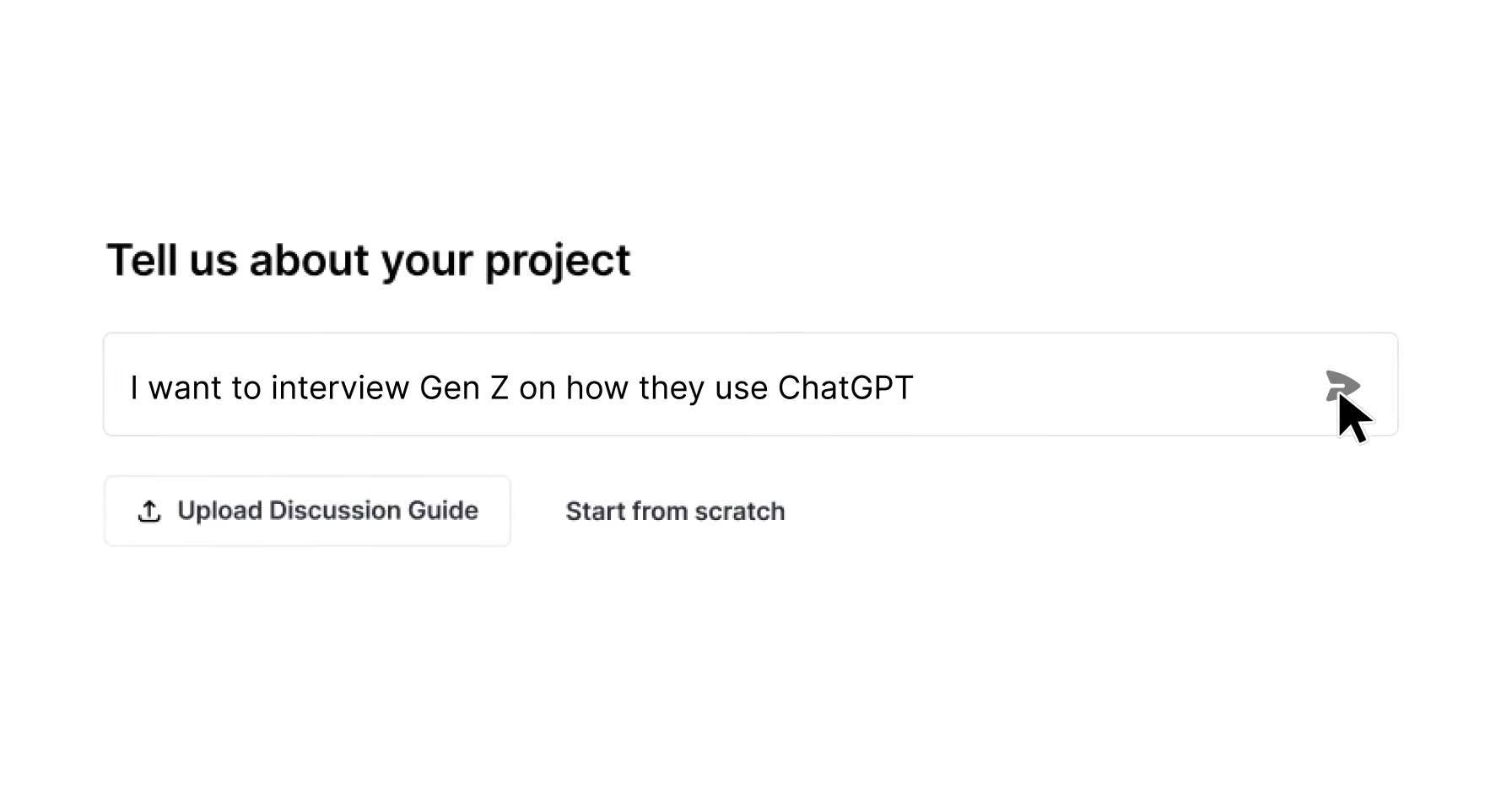
2. Identify Target Audience: Specify demographics, behaviors, and characteristics that describe your ideal participants. Listen Atlas then taps into 30M verified participants globally who match those criteria.
3. Choose Research Method: Use qualitative methods for “why” questions and quantitative methods for “how many” or “how often” questions. AI interviews combine both approaches by capturing rich narratives and turning them into structured data.
4. Recruit Participants: A sample size of around 400 respondents provides a margin of error of ±5% at a 95% confidence level. Quality Guard protects this step with fraud-proof recruitment and participant verification.
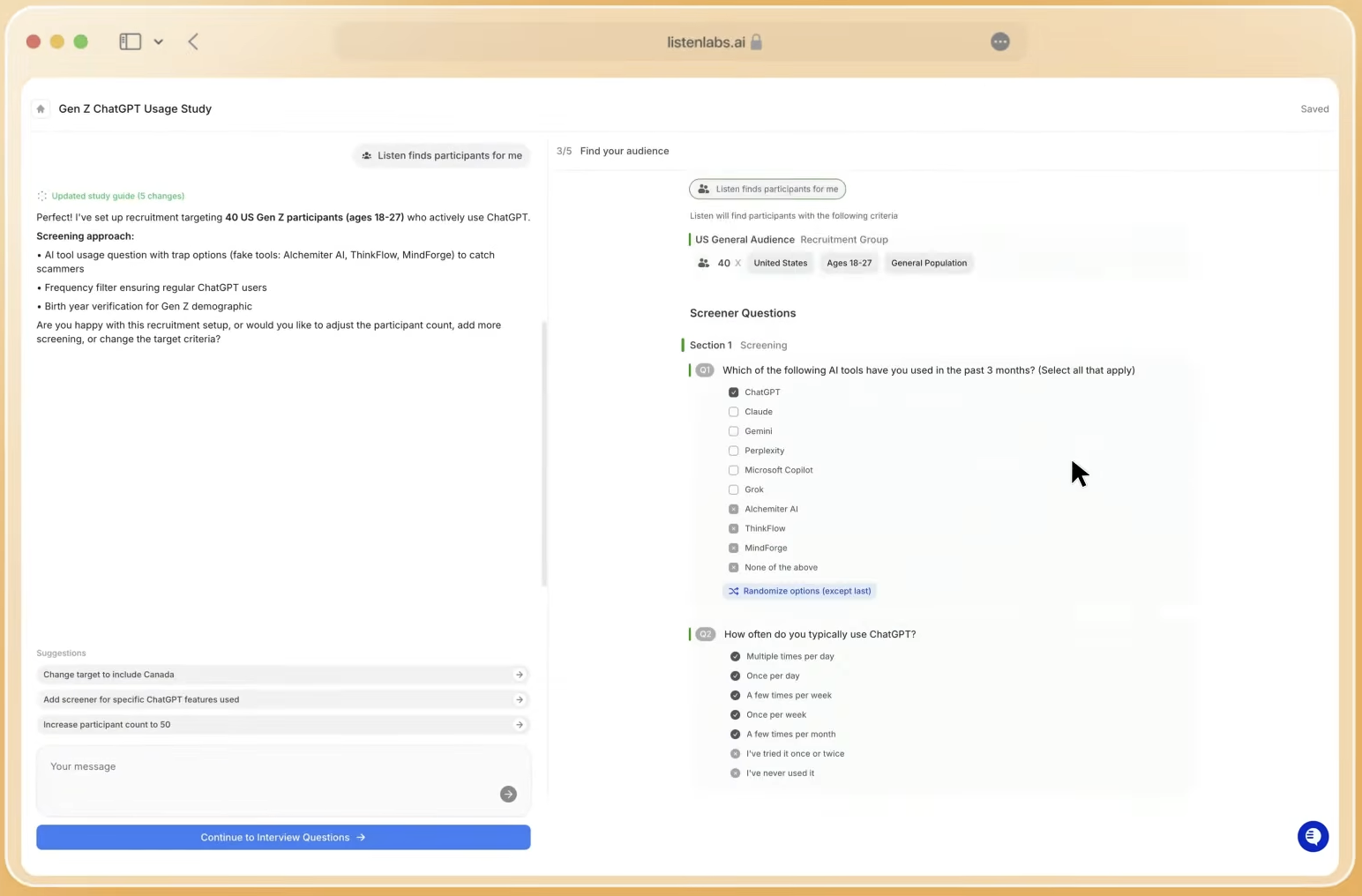
5. Collect Data: Run interviews or surveys with consistent moderation and clear instructions. AI moderation maintains quality across hundreds of simultaneous sessions without sacrificing depth.
6. Analyze Results: Research Agent handles the full analysis workflow: from raw data to final output. The tool generates themes, charts, and statistical comparisons so teams move quickly from data to decisions.
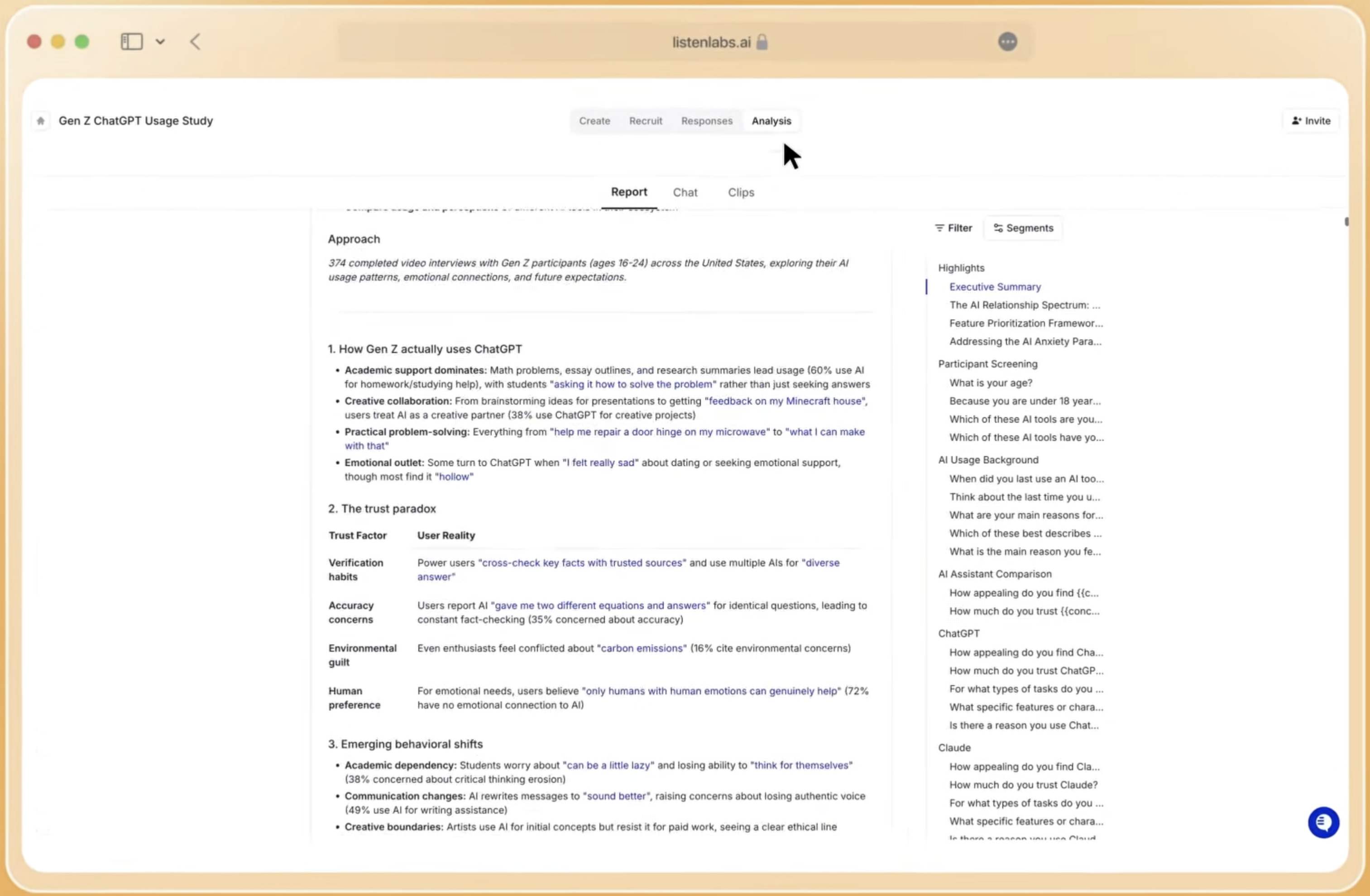
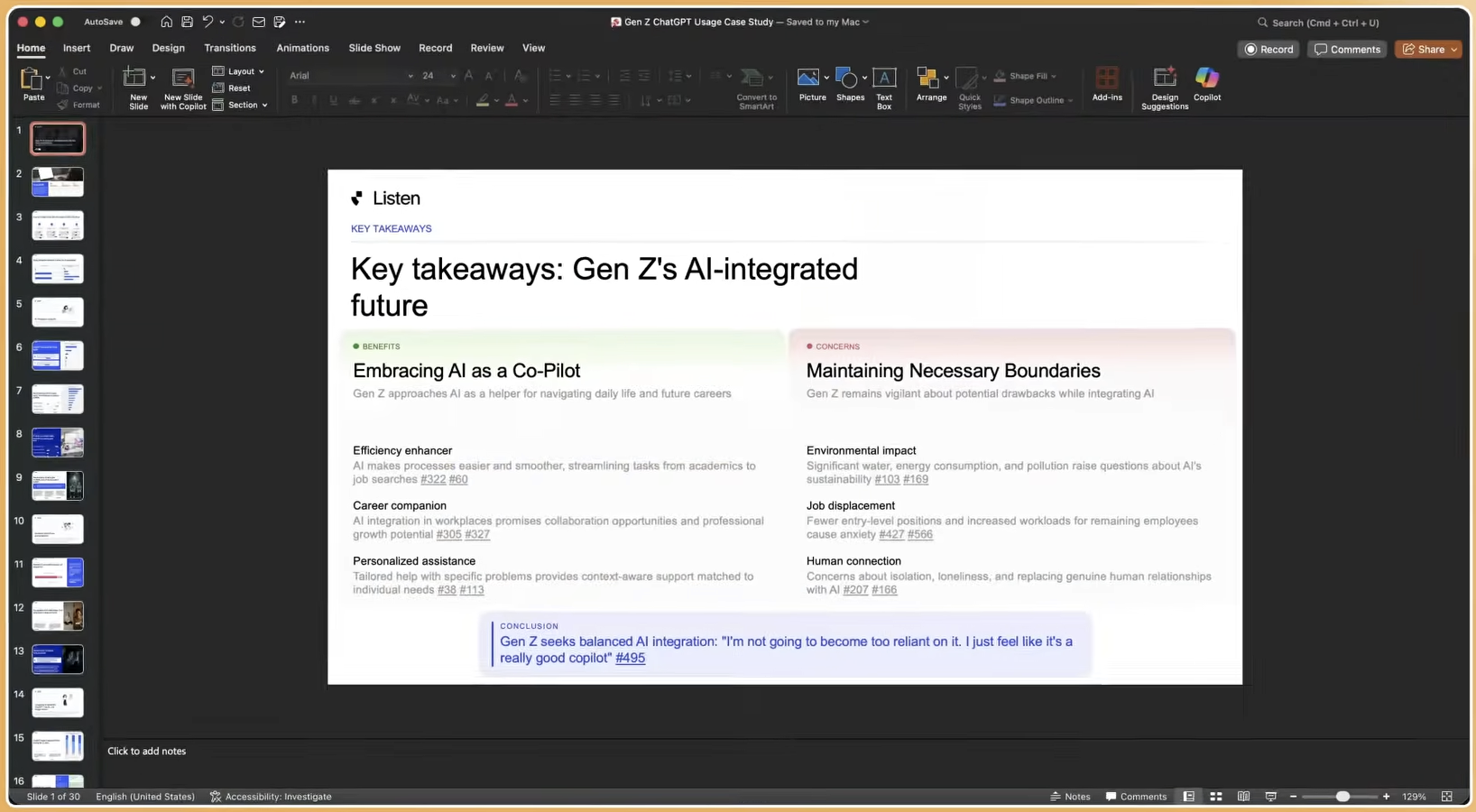
7. Act on Insights: Apply findings directly to product, pricing, and positioning decisions. Mission Control tracks trends over time and builds institutional knowledge your team can reuse.
This template approach enables startups to validate ideas systematically while avoiding common pitfalls that lead to product failures. To get the most value from this process, teams also need clear best practices and awareness of frequent mistakes.
Market Research Best Practices and Common Pitfalls
Strong market research starts with a few practical habits that protect quality. Essential best practices include starting small with pilot studies, avoiding leading questions that introduce bias, using mixed methods for more complete insights, and focusing on quality over sheer volume of responses. Cons of qualitative research include limited generalizability due to smaller sample sizes, potential researcher subjectivity in analysis, and high time and resource demands. Listen Labs addresses these issues through 3-study monthly limits that protect participant quality and Quality Guard fraud detection.
Common pitfalls often undermine otherwise solid research plans. These include poor sampling that skews results, ignoring emotional signals behind stated preferences, and relying only on self-reported data. Quantitative research risks survey bias from poor question design and lacks depth on underlying motivations. The 2026 shift toward qual-at-scale addresses these limitations by pairing statistical rigor with emotional intelligence and richer context.
Real-World Market Research Examples for Beginners
Concrete examples show how modern market research works in practice and how AI support changes the pace of learning.
Microsoft 50th Anniversary: Listen Labs collected global customer stories within a day, enabling Microsoft’s leadership team to gather user testimonials about Copilot’s impact at unprecedented speed and scale.
Anthropic Churn Analysis: 300+ user interviews in 48 hours surfaced why Claude users cancel subscriptions, identified migration patterns to competitors like OpenAI and Gemini, and delivered 10 prioritized “must-fix” items 5x faster than traditional methods.
P&G Claims Testing: 250+ interviews with quantified themes helped evaluate how men respond to new product claims. The work showed that comfort, safety, and reliability matter more than novelty, directly shaping product strategy in hours instead of weeks.
These examples demonstrate how AI-powered research delivers consultant-quality reports in minutes while maintaining methodological rigor and practical relevance.
Why Listen Labs Fits Beginner Market Research Needs
Listen Labs operates as an end-to-end AI research platform that replaces slow, manual workflows with automated, high-quality studies. The platform improves on UserTesting’s human-dependent model and Qualtrics’ survey-only focus by combining depth interviews, analysis, and participant recruitment in one place. Key advantages include 1/3 the cost of traditional research, a zero-fraud guarantee through Quality Guard, and global reach across 45+ countries. Traditional focus groups take 3-5 weeks and $4,000-$12,000 per 90-minute session. Listen Labs delivers comparable or richer insights at roughly one-third of that cost while maintaining the <24-hour turnaround highlighted earlier. Schedule a personalized demo to see how Listen Labs can support your next study.
FAQ
How do AI interviews compare to human-moderated research?
AI interviews through Listen Labs maintain the same methodological rigor as excellent human researchers while delivering significantly better experiences than under-resourced operations. The platform combines 50+ years of research expertise with AI capabilities to conduct adaptive, personalized conversations at scale. This combination ensures quality that matches or exceeds traditional approaches.
Can Listen Labs reach niche or hard-to-find audiences?
Yes. Listen Labs’ dedicated recruitment operations team partners with specialized networks to find participants below 1% incidence rates. These audiences include enterprise decision-makers, healthcare workers, engineers, and highly specific consumer segments across 45+ countries and 100+ languages.
How does pricing work for market research beginners?
Listen Labs uses a subscription model that includes platform access, a set number of studies, and credits. The platform then charges credits per recruited participant. Credit costs vary by audience difficulty, so general population studies use fewer credits than niche segments. Companies over 100 employees typically access the platform through demos and pilots, while smaller teams use self-serve options.
What security and privacy protections does Listen Labs provide?
Listen Labs maintains enterprise-grade security with 256-bit encryption and never uses customer data for AI model training. The platform holds SOC 2 Type II, GDPR, ISO 27001, ISO 27701, and ISO 42001 certifications. These standards ensure comprehensive data protection for all research activities.
Does Listen Labs provide research templates for beginners?
Yes. Listen Labs includes a template library for common research scenarios like concept testing, usability studies, brand perception research, and customer journey mapping. The AI-assisted study design feature helps beginners structure objectives, questions, and methodologies even without prior research expertise.
Conclusion
Market research in 2026 requires speed, scale, and depth that traditional methods rarely achieve. By following a clear process, applying best practices, and using AI-powered platforms, beginners can validate ideas and understand customers far faster than legacy approaches allow. Talk with the Listen Labs team today and start running market research at 2026 speed.