

Key Takeaways for AI Research Assistants
- Modern AI research assistants now handle full customer research cycles, shrinking 4–6 week projects into hours with NLP, sentiment analysis, and emotional intelligence.
- Listen Labs leads as the top end-to-end platform, with global recruitment from 30M respondents, AI-moderated interviews, and multimodal emotional analysis used by Microsoft and P&G.
- Specialized tools like HeyMarvin, Julius AI, and Crescendo.ai excel at feedback synthesis or quantitative analysis but do not cover the complete research workflow.
- Enterprise teams prioritize speed, cost efficiency, and fraud prevention, and Listen Labs delivers results in under 24 hours at one-third of traditional cost with zero-fraud Quality Guard.
- Teams can clear research backlogs with Listen Labs’ 24-hour pilot, and you can book a demo to see qual-at-scale insights in action.
1. Listen Labs: End-to-End AI Research for Customer Data
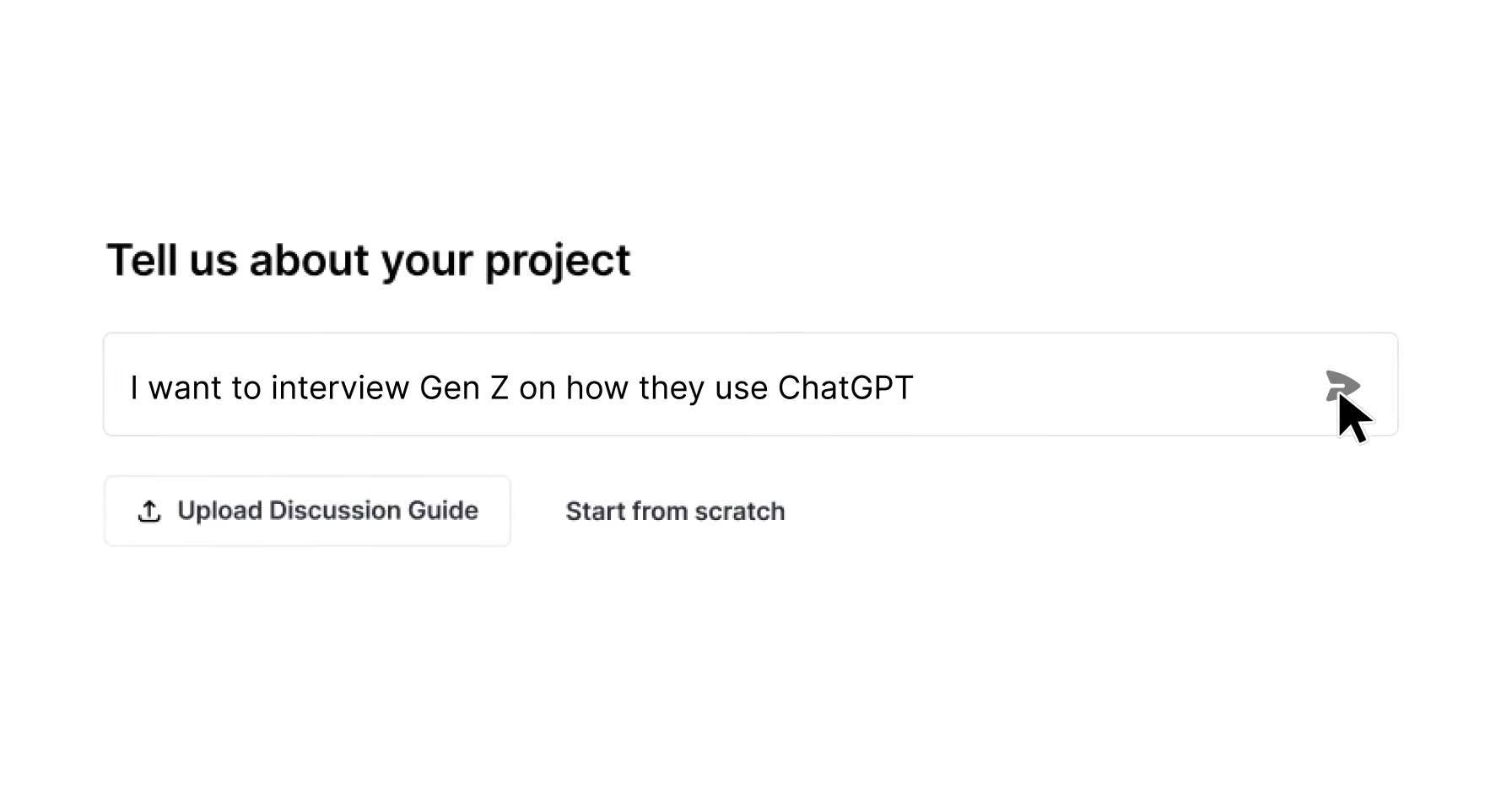
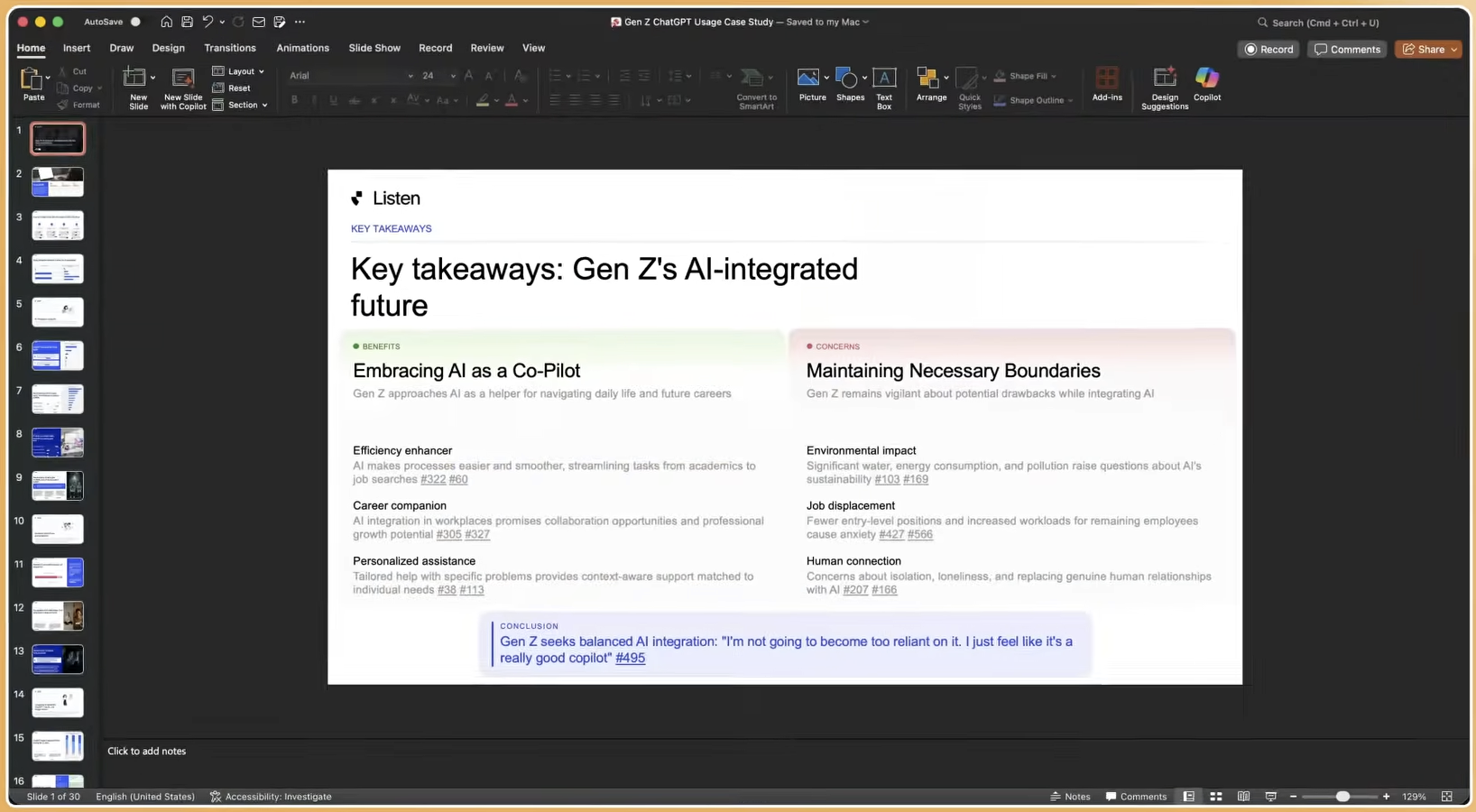
Listen Labs operates as a full-stack AI research platform for customer data analysis. It compresses traditional 4–6 week research cycles into less than 24 hours using the Listen Atlas network of 30M verified respondents across 45+ countries. Unlike point solutions that cover only one step, Listen Labs supports AI-assisted study design, global recruitment, AI-moderated video interviews, and automated analysis with consultant-grade deliverables.
The Emotional Intelligence engine gives teams a deeper view of customer reactions. It analyzes tone of voice, word choice, and micro-expressions to reveal emotions that transcripts alone cannot show. Built on Ekman’s universal emotions framework, each emotion is quantified per question and linked to exact timestamps. This closes the gap between what customers say and what they actually feel, which most tools overlook.
Fortune 500 teams validate the platform at scale. Microsoft used Listen Labs to collect global customer stories for its 50th anniversary within a single day. Procter & Gamble used it to evaluate product claims through more than 250 interviews. The Quality Guard system blocks fraud with three layers of protection: behavioral matching, real-time AI monitoring, and dedicated recruitment operations with strict participant frequency limits.
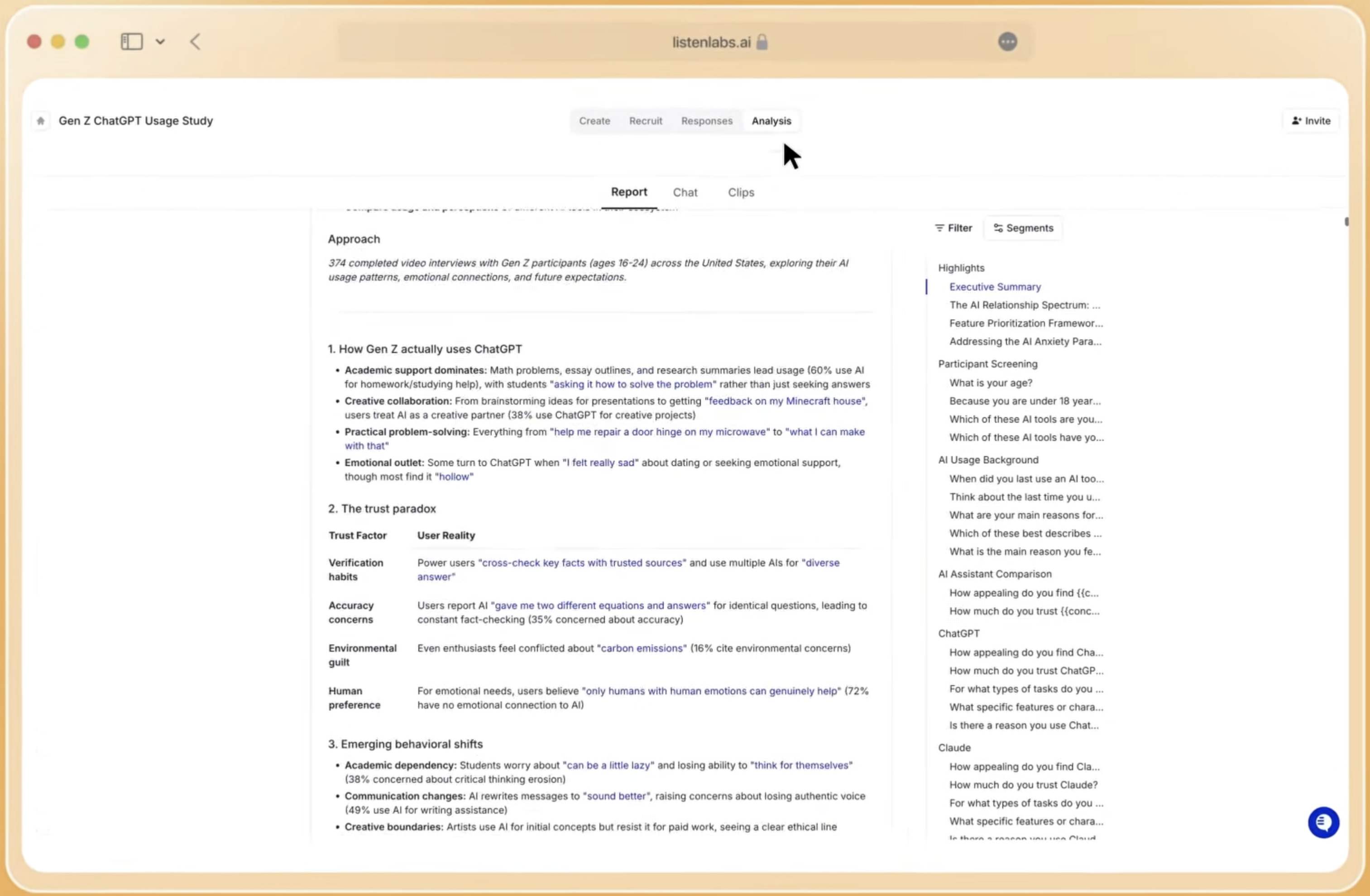
The Research Agent produces slide decks, highlight reels, and statistical analyses in under a minute. Mission Control acts as a growing knowledge base that compounds with every study. Tens of thousands of completed projects feed a data flywheel that improves question quality and analysis over time, creating a moat that point tools cannot match.
2. HeyMarvin: Central Hub for Existing Feedback
HeyMarvin serves as an AI-native insights platform for managing and analyzing existing feedback repositories. It organizes and synthesizes customer feedback from multiple sources, using natural language processing to surface themes and patterns across large datasets. Teams can upload transcripts, survey responses, and support tickets for automated tagging and sentiment analysis.
HeyMarvin does not include recruitment or interview moderation, which limits end-to-end workflows. Teams must source participants, schedule sessions, and conduct interviews in other tools, then import the data. This fragmented process introduces delays and quality risks that enterprise teams struggle to accept when deadlines and stakeholders demand fast answers.
3. Julius AI: Spreadsheet and Quantitative Analysis
Julius AI focuses on spreadsheet and quantitative data analysis, which appeals to teams seeking free AI tools for market research. It processes structured datasets, then generates charts, statistical summaries, and trend analyses from survey responses and numerical data.
The platform specializes in quantitative pattern detection rather than qualitative depth. Julius AI cannot recruit participants, run interviews, or capture emotional nuance that often drives behavior. For teams that need rich conversational insights or a full research workflow, Julius AI works best as a supporting analysis layer instead of a primary research platform.
4. Crescendo.ai: Support Conversation Intelligence
Crescendo.ai focuses on analyzing customer support interactions across chat, voice, email, and SMS for real-time insights, positioning it as a specialized voice-of-customer platform. It offers strong sentiment analysis and highlights pain points from existing support conversations.
The platform centers on reactive support data, not proactive research. Crescendo.ai does not recruit new participants or run structured interviews around specific research questions. Teams that want to explore motivations beyond support tickets need additional tools for a complete view of the customer.
5. Speak: Post-Interview Video and Audio Analysis
Speak targets video and audio analysis for qualitative research and provides transcription with basic sentiment analysis. It processes recorded interviews and focus groups, identifies speakers, and generates searchable transcripts with accurate timestamps.
Speak focuses on analysis after interviews, not on running the research itself. It does not offer recruitment infrastructure or AI moderation for live sessions. Teams must manage sourcing, scheduling, and facilitation elsewhere, which adds operational overhead and slows research timelines.
Comparison Matrix: Time, Cost, and Emotional Depth
|
Tool |
Time to Results |
Cost Efficiency |
Emotional Analysis |
Enterprise Proof |
|
Listen Labs |
<24 hours |
1/3 traditional cost |
Advanced multimodal |
Microsoft, P&G |
|
HeyMarvin |
2–3 days |
Moderate |
Basic sentiment |
Limited |
|
Julius AI |
Hours |
Free tier |
None |
None |
|
Crescendo.ai |
Real-time |
Moderate |
Support-focused |
Limited |
6. Otter.ai: Transcription for Meetings and Calls
Otter.ai focuses on meeting transcription and light analysis for internal conversations and customer calls. It generates accurate transcripts with speaker labels and can pull out action items from recorded sessions.
Otter.ai does not include research-specific features such as participant recruitment, structured interview guides, or deep analysis. It supports collaboration and note-taking but cannot replace a dedicated research platform when teams need robust customer insights.
7. Qualtrics XM: Scalable Survey Infrastructure
Individual contributors in research cite budget constraints (42%), speed to insights (40%), and keeping up with new methods (40%) as top challenges. Qualtrics XM addresses these needs with a mature survey platform and AI-enhanced analytics. It excels at quantitative data collection and handles large-scale survey responses with strong statistical methods.
Qualtrics does not match the conversational depth or AI moderation that modern qualitative research requires. Conversational methods generate 2.5x longer responses than surveys, and up to 8x with video and AI probes. These results highlight how traditional surveys fall short when teams need rich, exploratory insights.
8. quantilope: Automated Quantitative Research
quantilope delivers automated quantitative research with AI-assisted survey design and analysis. It can generate questionnaires from research objectives and then provide statistical analysis with clear visualizations.
The strong quantitative focus limits its ability to explain the “why” behind behavior. quantilope does not conduct qualitative interviews or capture emotional signals that influence decisions. Teams often pair it with qualitative tools to build a complete picture of the customer journey.
9. Medallia: Enterprise Voice-of-Customer Platform
Medallia operates as a large-scale voice-of-customer system that collects feedback across many touchpoints and runs sentiment analysis at scale. It integrates with existing customer systems and pulls data from surveys, reviews, and support channels.
The platform often requires multiple integrations and long implementation cycles. Medallia does not recruit new participants or run structured research studies, which limits its role for proactive insight generation and exploratory research.
10. Sprinklr: Social Listening and CX Monitoring
Sprinklr offers omnichannel customer experience management with AI-powered social listening and sentiment analysis. It tracks brand mentions across social media, reviews, and digital channels to surface trends and shifts in sentiment.
Sprinklr focuses on reactive monitoring rather than structured research. It does not provide recruitment workflows or interview capabilities for targeted studies. Teams that need deep exploration of specific segments still require a dedicated research platform.
Workflow Blueprint: How a Modern AI Research Stack Runs
The strongest AI research assistant for customer data analysis covers the entire research lifecycle in one place. Using Listen Labs as a benchmark, the workflow starts with a natural language brief where teams describe goals and receive AI-generated interview guides within minutes. The platform then recruits 300 or more participants from verified global panels, runs parallel AI-moderated video interviews with dynamic follow-up questions, and analyzes responses with multimodal emotional intelligence.
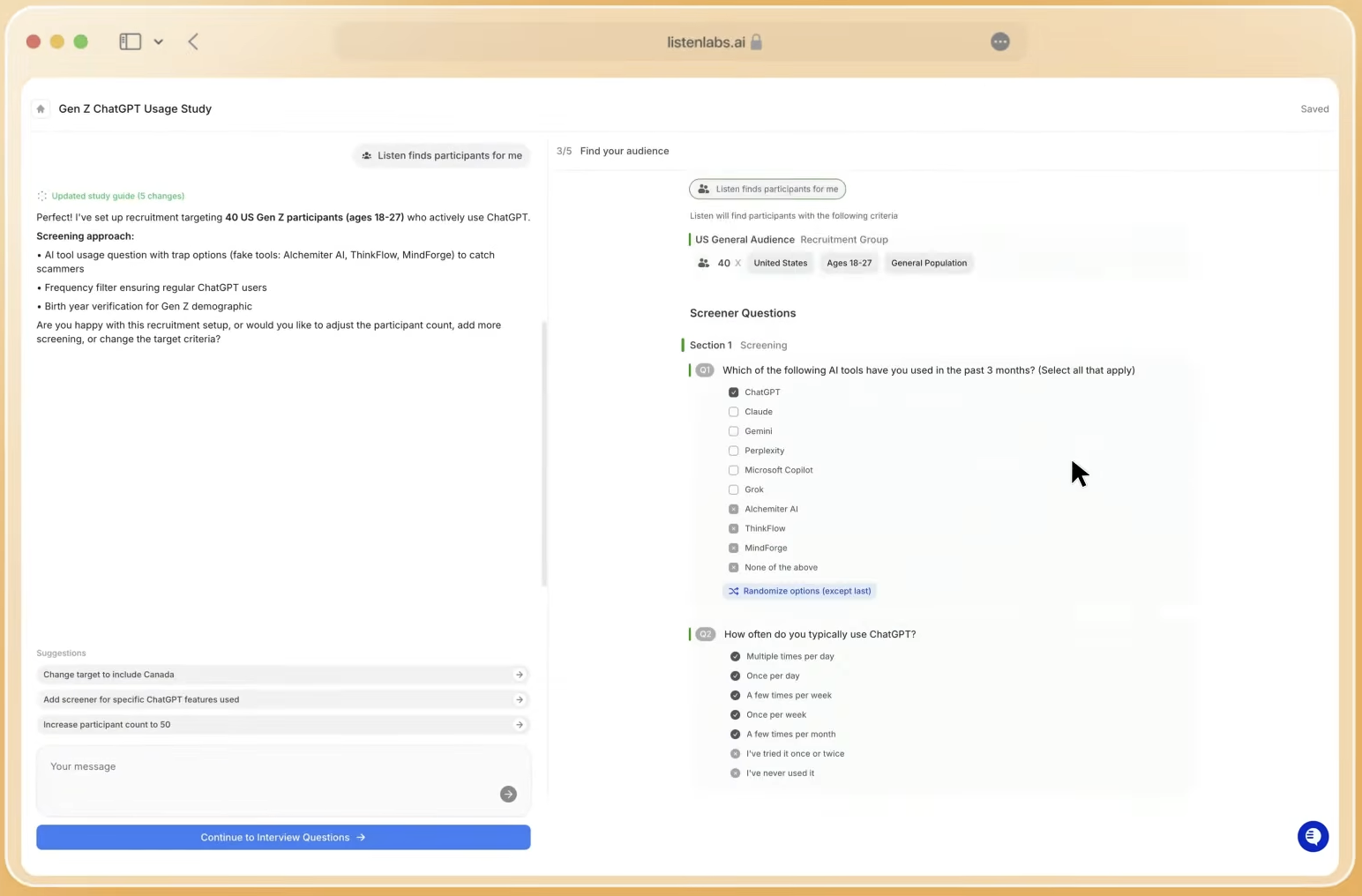
Within 24 hours, teams receive consultant-quality slide decks, statistical charts, video highlight reels, and a searchable insight repository. This end-to-end model removes the manual logistics that usually stretch research into weeks. Book Listen Labs demo for ai research assistant for customer data analysis tools—get 24hr pilot to see this workflow in practice.
Free vs Paid AI Research Assistants
|
Tool Type |
Depth |
Scale |
Security |
|
Free (ChatGPT, Julius AI) |
Surface-level |
Limited |
Basic |
|
Paid (Listen Labs) |
Conversational depth |
Thousands parallel |
SOC2, GDPR |
|
Enterprise (Medallia) |
Moderate |
High volume |
Enterprise-grade |
Free AI tools for market research offer basic analysis but lack recruitment, moderation, and advanced security that enterprises require. Paid platforms like Listen Labs provide the depth, scale, and compliance that Fortune 500 research teams expect.
FAQ
How does AI interviewing compare to human moderation quality?
AI interviewers in 2026 match the methodological rigor of experienced human researchers while adding consistency and scale. Listen Labs’ AI runs personalized conversations with dynamic follow-up questions that reach the same depth as human interviews. It avoids variability, scheduling conflicts, and geographic limits that constrain human moderators, while 50+ years of combined research expertise guide the underlying methodology.
What fraud prevention measures do AI research platforms implement?
Leading platforms rely on multi-layer fraud detection. Listen Labs’ Quality Guard tracks behavioral patterns, real-time video and voice signals, content authenticity, and device fingerprints to remove fraudulent responses. Participants can join only three studies per month, and the system maintains reputation scores across interviews. This approach achieves zero fraud compared with commodity panels where professional survey-takers often distort data.
Can AI research assistants reach niche audiences below 1% incidence rates?
Advanced platforms like Listen Labs reach niche audiences by combining AI orchestration with dedicated recruitment teams. The Atlas network covers 30M verified respondents across 45+ countries, and specialized partners extend reach to enterprise decision-makers, healthcare professionals, engineers, and other hard-to-find groups. This hybrid model often outperforms traditional panel providers on difficult recruitment briefs.
Will AI research tools replace human research teams?
AI research assistants augment human researchers instead of replacing them. These tools automate recruitment, scheduling, transcription, and first-pass analysis, which frees teams to focus on interpretation, stakeholder storytelling, and methodology design. Organizations using AI platforms usually increase research output by 5–10x without matching headcount growth.
How do AI research platforms compare to traditional survey tools like Qualtrics?
Traditional surveys collect structured responses to fixed questions and cannot probe deeper when something interesting appears. AI research platforms run conversational interviews where the system adapts in real time and asks follow-up questions based on each answer. This approach uncovers emotional nuance, motivations, and context that surveys miss, while still supporting large samples and strong statistical confidence.
Conclusion: Why Listen Labs Leads AI Customer Research
Listen Labs stands out as the most complete AI research assistant for customer data analysis, clearing enterprise backlogs with end-to-end automation and qual-at-scale capabilities. Specialized tools like Julius AI help with specific analysis tasks, and platforms like Qualtrics excel at quantitative surveys, but they do not deliver full workflow transformation.
Listen Labs combines global recruitment, AI-moderated interviews, emotional intelligence analysis, and automated deliverables into one system that reflects the future of customer research. Teams that want to multiply research output while protecting methodological rigor can rely on Listen Labs to remove trade-offs between depth, scale, and speed. Book Listen Labs demo to upgrade your research operations.